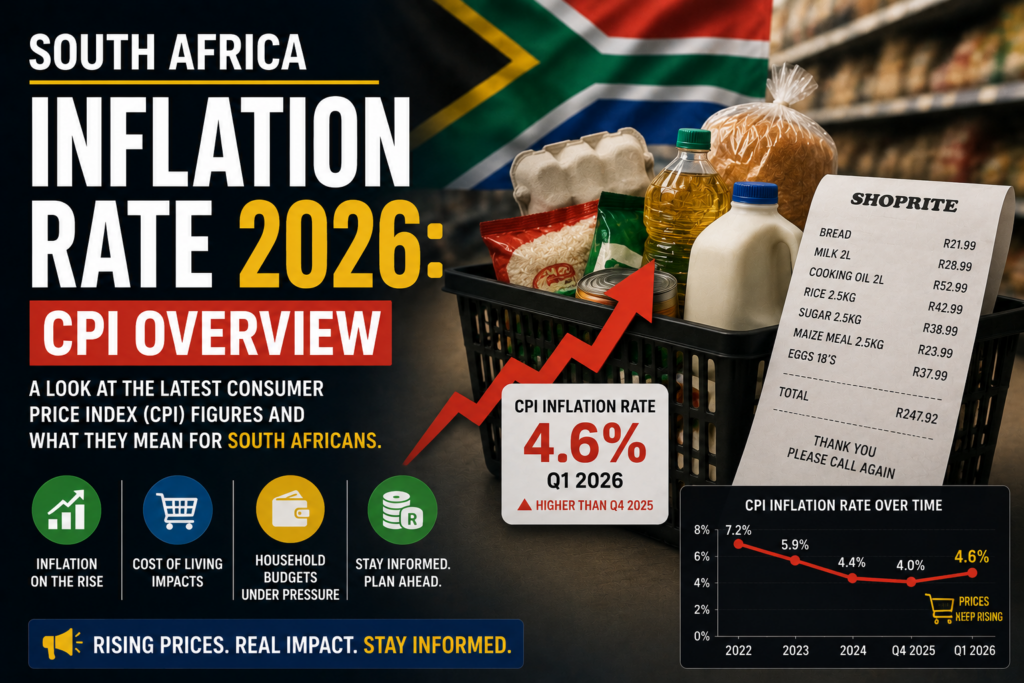
South Africa’s annual inflation rate rose to 4.5% in May 2026, up from 4.0% in April — the third consecutive monthly increase, according to Statistics South Africa’s Consumer Price Index (CPI) release. The rise was driven largely by transport costs, which jumped to 9.4% year-on-year from 4.9% the previous month, and by housing and utilities costs, which rose 5.3%, reflecting the impact of Eskom’s latest electricity tariff increase.
What’s pushing prices higher
Two categories did most of the work behind May’s higher inflation figure:
- Transport (9.4% year-on-year, up from 4.9% in April): largely a fuel price pass-through effect, as global oil price movements and rand exchange-rate shifts fed into pump prices over the preceding months.
- Housing and utilities (5.3%): reflecting the impact of NERSA-approved electricity tariff increases working their way through municipal bills.
Inflation remains within the South African Reserve Bank’s target band, generally understood to run from around 3% to 6%, but the upward trend across three consecutive months was enough to factor into the Reserve Bank’s decision to raise interest rates — see our related report on the SARB’s rate hike to 7%.
Why the inflation rate matters beyond the headline number
CPI inflation is an average across a broad basket of goods and services, which means the headline 4.5% figure can understate the pressure felt by lower-income households, who typically spend a larger share of their income on necessities like transport, food and electricity — the very categories driving this increase — and a smaller share on discretionary goods where price increases may have been milder.
How this connects to fuel and electricity specifically
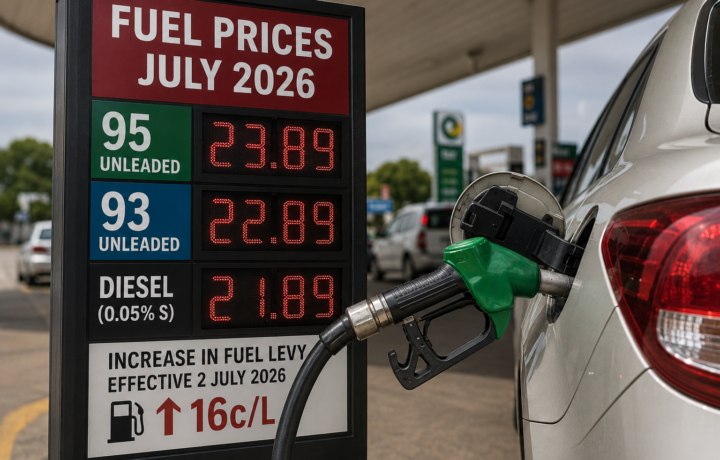
Transport costs are especially sensitive to global oil prices and the rand exchange rate, both of which can shift quickly and are largely outside domestic policy control. Our coverage of July’s petrol price changes and the reinstated fuel levy looks at how fuel costs have moved since this inflation data was published, including a partial reversal as global oil prices eased. On the electricity side, Eskom’s operational turnaround — covered in Eskom’s 400 days without load shedding — has improved supply reliability, but tariff increases approved to fund that turnaround are a separate cost pressure working in the opposite direction for consumers.
What this means for household budgets
- Households relying heavily on private transport are likely to feel inflation more acutely than the headline figure suggests, given transport’s outsized contribution to this increase.
- Electricity-linked cost increases affect virtually every household, regardless of transport habits, since housing and utilities costs are a near-universal budget line.
- Rising inflation also has a knock-on effect on interest rates, as seen in the Reserve Bank’s May 2026 hike — meaning higher living costs and higher borrowing costs can arrive together.
Background: how CPI inflation is measured
Statistics South Africa calculates CPI by tracking price changes across a representative basket of goods and services that reflects typical household spending patterns, weighted according to how much of an average household’s budget goes toward each category. Because the basket is an average, individual households can experience inflation quite differently depending on their specific spending patterns — a lower-income household spending a larger share of income on transport and electricity, for example, may experience effective inflation above the headline number during a period like this one.
What happens next
Stats SA’s subsequent CPI releases will show whether May’s upward trend continued into June and beyond, which will in turn feed into the Reserve Bank’s next interest rate decisions. Economists were watching the June figure closely, given its role in determining whether the MPC held rates steady or raised them further at its next meeting.
Why economists watch “core” inflation alongside the headline figure
Statisticians and economists often distinguish between headline CPI inflation and “core” inflation, which strips out historically volatile categories like fuel and food to give a sense of underlying price pressure in the rest of the economy. When headline inflation is being driven substantially by transport and housing/utilities costs, as was the case in May 2026, it can suggest the increase is concentrated in specific, identifiable pressures rather than reflecting broad-based price increases across the entire economy — a distinction that matters for how the Reserve Bank calibrates its policy response, since broad-based inflation is generally considered harder to bring under control through interest rate policy alone than inflation concentrated in a few volatile categories.
How South Africa’s inflation compares with recent years
An inflation rate of 4.5% sits comfortably within the Reserve Bank’s target band and is considerably lower than the inflation spikes South Africa experienced during the global post-pandemic price surge of 2022, when inflation briefly pushed well above target. Viewed against that recent history, May 2026’s reading reflects a relatively contained inflation environment overall — the concern raised by economists was less about the absolute level and more about the consistent upward trend across three consecutive months, which can be an early signal of building pressure even from a moderate starting point.
How rising costs compound for lower-income households
Because lower-income households typically spend a larger share of their budget on transport and housing/utility costs — precisely the categories driving May’s inflation increase — a headline rate of 4.5% likely understates the effective inflation experienced by many poorer households. This “inflation inequality,” where different income groups experience meaningfully different effective inflation rates depending on their specific spending patterns, is a recurring feature of South Africa’s cost-of-living debate and a reason economists caution against treating the single headline CPI figure as equally representative of every household’s experience.
Why the rand exchange rate matters so much for inflation
Because South Africa imports a significant share of its fuel and various other goods, movements in the rand’s exchange rate against major currencies feed fairly directly into domestic price levels — a weaker rand generally makes imports, including fuel, more expensive in rand terms, while a stronger rand can ease that pressure. This is part of why inflation data, currency movements and interest rate decisions are so closely intertwined in South African economic commentary: each influences and responds to the others in a continuous feedback loop that policymakers have to navigate together rather than in isolation.
Why “third consecutive increase” matters more than any single month
A single month’s inflation uptick can reflect a temporary or seasonal factor. Three consecutive monthly increases, by contrast, is the kind of pattern central banks and economists take more seriously as a potential trend rather than noise — which is precisely why the Reserve Bank’s rate decision, discussed in our related coverage, was framed as pre-emptive rather than reactive to this specific data point alone.
Why South Africans should expect inflation data to keep making headlines
With interest rate decisions, fuel price movements and municipal tariff increases all feeding into the same inflation figure each month, CPI data is likely to remain one of the most closely watched economic releases for South African households through the rest of 2026, particularly given the Reserve Bank’s evident sensitivity to sustained upward trends rather than single-month readings alone.
Frequently asked questions
What is the Reserve Bank’s inflation target?
The SARB generally targets inflation within a band of roughly 3% to 6%, aiming to keep price increases moderate and predictable rather than eliminating inflation entirely.
Why did transport costs rise so much in May 2026?
The increase largely reflects a fuel price pass-through effect from earlier movements in global oil prices and the rand exchange rate working their way into the inflation data.
Sources Used
- Statistics South Africa — Consumer Price Index, May 2026
- Trading Economics — South Africa CPI data