
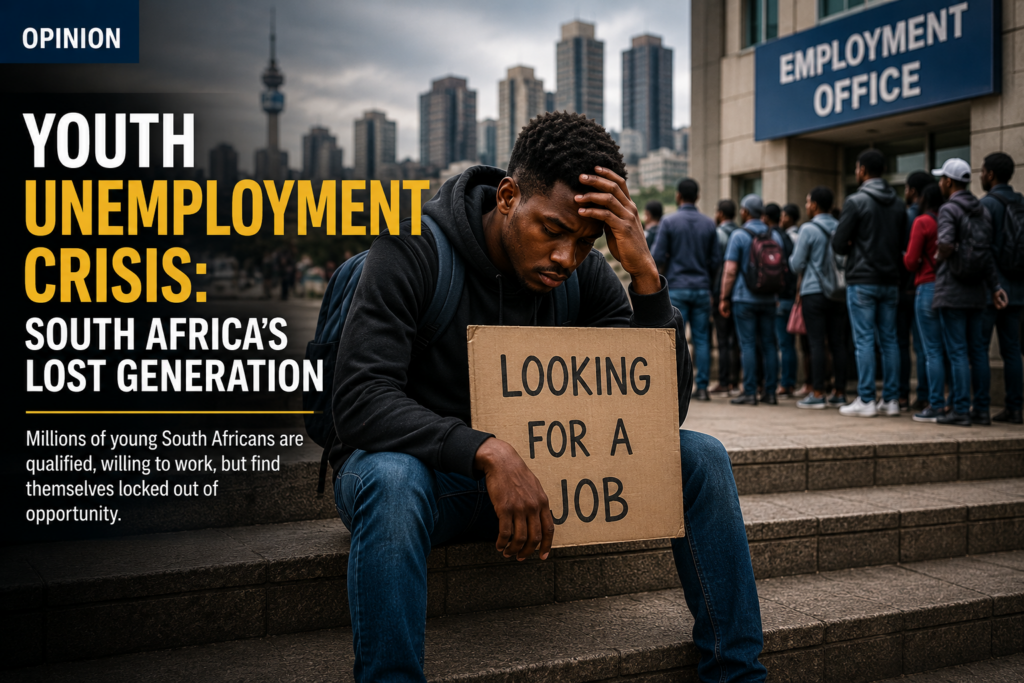
This is an opinion and analysis piece, presenting the writer’s argument on a contested policy question. It should be read as analysis, not as a neutral news report.
Youth unemployment in South Africa sat at 45.8% in the first quarter of 2026, according to Statistics South Africa’s Quarterly Labour Force Survey — see our full report on the latest unemployment figures. Among the narrower 15–24 age band, the rate climbs closer to 61%. These are not new problems; South African youth unemployment has run at crisis levels for well over a decade, through multiple governments, budgets and skills initiatives. That persistence is itself the most important data point in this debate — it suggests the standard policy response has not been proportionate to the scale of the problem.
The instinct to reach for skills programmes is understandable
Skills mismatches are real. Employers do sometimes struggle to fill specific technical roles even amid high unemployment, and there’s a reasonable case that some young work-seekers lack the specific, market-relevant skills employers are looking for. Programmes aimed at closing that gap — apprenticeships, learnerships, TVET college expansion — are not wrong to pursue. They’re just consistently treated as if they’re sufficient on their own, when the evidence suggests they’re addressing only part of a larger problem.
The demand side is the part that gets less attention
A skills programme can only convert into a job if there is a job to be converted into. South Africa’s economy has been growing, but at a pace — averaging under 2% in recent years — that most economists agree is too slow to absorb new entrants to the labour force at scale, let alone reduce the existing backlog of unemployed young people. Formal job losses reported for early 2026 — covered in our report on South Africa’s formal job losses — are a reminder that the demand side of this equation has been moving in the wrong direction even as skills initiatives continue.
Training someone for a job that doesn’t exist yet doesn’t create employment. It creates a more qualified unemployed person.
The absorption rate tells an uncomfortable story
One of the more revealing figures in South Africa’s youth employment data is the youth absorption rate — the share of young people who are actually employed — which sits at around 10.1%, the lowest of any age band measured. That figure captures something skills-focused framing tends to obscure: even young people who complete training and qualifications are being absorbed into employment at strikingly low rates, which points toward a constraint on job creation itself, not primarily a shortfall in young people’s qualifications.
What a more honest policy conversation would include
- Growth, not just training. Faster, more broad-based economic growth remains the single most reliable driver of job creation at scale — no skills programme can substitute for an economy generating enough new positions to absorb new entrants.
- The cost of hiring. Compliance costs, labour market rigidities and hiring risk all factor into how willing businesses are to take on young, inexperienced workers — a conversation that sits uncomfortably alongside skills-focused messaging but is difficult to avoid honestly.
- First-job pathways. Programmes that specifically reduce the risk and cost of hiring a first-time work-seeker — subsidised placements, extended probation-style arrangements, employer incentives tied to genuine retention — address the “no experience, no job; no job, no experience” trap more directly than generic skills training alone.
Why this matters beyond economics
Analysts have described youth unemployment as one of South Africa’s most significant political and social risks, not merely an economic statistic — it feeds into crime, migration pressure, and a broader sense of exclusion among a generation that has, in many cases, done everything asked of it — finished school, sought further training — without a job at the end of it. A policy response calibrated to the scale of that risk would look considerably more urgent, and more focused on job creation itself, than one built primarily around expanding the supply of trained young people.
Where this leaves the debate
None of this is an argument against skills development — it remains a necessary part of any credible response. It’s an argument against treating it as sufficient, when the data increasingly suggests South Africa’s youth unemployment crisis is, at its core, a jobs-creation problem wearing a skills-gap costume. Until that gets acknowledged plainly in policy design, the headline unemployment figures are unlikely to move much, regardless of how many new training programmes are announced.
Sources Used
- Statistics South Africa — Quarterly Labour Force Survey, Q1 2026
- IOL — 'South Africa's job crisis deepens as youth unemployment nears 46%'
What “demand-side” solutions could look like in practice
If the core constraint is genuinely insufficient job creation rather than a skills gap alone, the policy toolkit shifts toward measures that reduce the cost and risk employers face when hiring young, inexperienced workers. Wage subsidies for first-time employment, tax incentives tied to net new youth hires rather than simply any hire, and streamlined, lower-risk trial employment arrangements have all been proposed in various forms in South African policy debate over the years, with mixed and contested evidence on their effectiveness. None represents a complete solution on its own, but a policy mix weighted more heavily toward reducing employer hiring risk, alongside continued skills investment, would represent a meaningfully different emphasis than the current, more training-centred approach.
Why this is also a growth story, not only a labour policy story
It bears repeating that no combination of youth-specific labour market interventions can substitute for an economy growing fast enough to create jobs at scale. South Africa’s growth has averaged well under the roughly 3% economists generally cite as the threshold needed to meaningfully reduce unemployment over time. This means the youth unemployment crisis is, in an important sense, downstream of the same broader growth constraints — energy reliability, logistics bottlenecks, investment climate — that appear repeatedly across Newsdomain’s economic coverage, rather than a problem that can be solved through youth-targeted policy alone, however well designed.
Why comparisons with other emerging economies are instructive but imperfect
Other emerging economies with large youth populations have taken varied approaches to youth unemployment, from large public employment programmes to targeted industrial policy aimed at labour-intensive sectors. None offers a template that transfers directly to South Africa’s specific circumstances, given differences in industrial structure, education systems and labour market regulation — but the common thread across more successful cases has generally been sustained, above-average economic growth over an extended period, reinforcing that growth, not any single youth-targeted programme, tends to be the decisive factor.
What “starting the clock earlier” could mean in practice
Some youth employment specialists have argued South Africa’s interventions arrive too late in a young person’s trajectory — focused heavily on post-school training and job placement, with comparatively less attention to foundational literacy and numeracy failures earlier in the schooling system that make later skills training less effective than it could be. If foundational education gaps are a meaningful contributor to weak youth employment outcomes, as some research suggests, addressing them would require a much longer-term view than any programme targeted at school-leavers or graduates alone can provide.
Why measuring success matters as much as designing the policy
Any renewed policy effort on youth unemployment should also be judged by whether it sets clear, measurable targets and timelines against which progress can genuinely be tracked, rather than being assessed primarily by the number of programmes announced. South Africa has no shortage of youth employment initiatives launched over the years; what has been comparatively scarce is rigorous, independent evaluation of which of those initiatives actually moved the underlying employment numbers, and by how much.