This is an opinion and analysis piece, presenting the writer’s argument alongside multiple perspectives. It should be read as analysis of a live political debate, not a neutral news report.
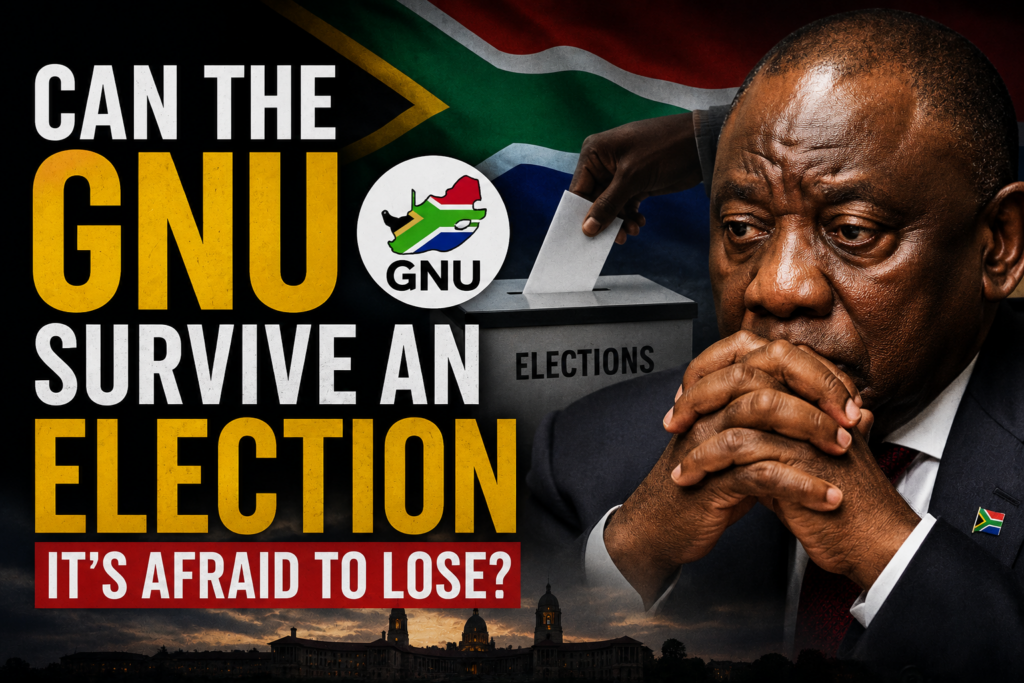
South Africa’s Government of National Unity was born out of necessity, not enthusiasm. When the ANC lost its outright parliamentary majority in the May 2024 election, a multi-party coalition was the practical response to a genuinely new political reality. Two years on, with local government elections due before the end of January 2027, the question worth asking isn’t whether the GNU has been perfect — no coalition is. It’s whether the arrangement is built to survive a contest that will, by its nature, push its constituent parties toward campaigning against each other while still governing together.
The case that the GNU has held up reasonably well
It’s easy to lose sight of the baseline: many predicted, when the coalition formed, that an ANC-DA arrangement — pairing parties with genuinely different ideological traditions — would collapse quickly under its own contradictions. It hasn’t. The 2026 Budget passed with a VAT increase withdrawn rather than forced through over DA objections, suggesting real negotiation rather than either party simply imposing its will. A recent cabinet reshuffle — see our report on Ramaphosa’s move of Steenhuisen off Agriculture — was managed as an internal DA personnel decision within the coalition framework rather than a rupture between coalition partners. These are not the signs of a government about to fall apart.
The case for real concern
But process holding together is not the same as trust deepening. Public clashes between DA figures and cabinet direction — including friction over the pace of B-BBEE reform, discussed in our report on the proposed R20 billion Transformation Fund, and over state-owned enterprise policy — have been visible rather than resolved quietly behind closed doors. That visibility matters: coalition partners who are confident in their arrangement generally prefer to resolve disagreements privately rather than let them play out in public, because public disagreement signals to voters — and to each other — that the partnership has limits.
The more structural concern is that the GNU has no clearly established, tested mechanism for resolving a genuine deadlock between its two largest partners. Everything so far has been managed through negotiation and, evidently, some compromise. Whether that holds under the pressure of an actual electoral contest, where both parties need to show distinct value to their own voters rather than a blended, negotiated position, is untested.
Why local elections are a harder test than the coalition has faced yet
National coalition governance and local election campaigning pull in opposite directions. Governing together requires the ANC and DA to present compromises as workable governance. Campaigning against each other for the same municipal voters requires each party to draw sharp distinctions from the other — to argue, implicitly or explicitly, that its approach is better than its coalition partner’s. Doing both at once, credibly, is a genuinely difficult balancing act that the GNU has not yet had to perform under real electoral pressure, since it formed after, not before, the 2024 national vote.
What would actually indicate the GNU is fragile
The test isn’t whether disagreements happen — coalition government without disagreement would be a sign of one party dominating rather than genuine power-sharing. The test is whether disagreements get resolved through the coalition’s own negotiation processes, or whether one party starts threatening to walk out, or governs unilaterally around its partner, as a matter of routine. So far, the pattern looks more like the former than the latter — but a contested local election result, particularly in metros where coalition dynamics get replicated at municipal level, will be a much sharper test than anything the GNU has faced at national level to date.
What would indicate real resilience
A GNU that survives its first electoral test intact — even with bruised feelings and some public sniping along the way — would be a meaningfully different, more durable proposition than one that has simply avoided its first real stress test so far. South Africans watching this unfold should distinguish between the two: surviving because the test hasn’t come yet is not the same as surviving the test.
Where this leaves the debate
The GNU deserves credit for functioning better than many predicted at its formation. It has not yet been asked to prove it can survive its parties actively competing against each other for the same voters while continuing to govern jointly. That test is coming, on a fixed timeline, before the end of January 2027 — and how it’s handled will say more about the coalition’s real durability than anything that has happened so far.
Sources Used
- EBNewsDaily — GNU coalition tensions reporting, April 2026
- Wilson Center — 'South Africa's Government of National Unity: New Political Coalitions'
What a coalition breakdown would actually look like
It’s worth being precise about what “GNU collapse” would mean in practice, since the term gets used loosely in public debate. A full collapse would likely involve one major partner formally withdrawing from the coalition agreement, potentially triggering a motion of no confidence or a reconfigured government requiring new negotiations, possibly with different partners. A more limited but still significant scenario would be a partner remaining formally in the coalition while effectively withdrawing cooperation on major legislation or budget votes — a functional breakdown without a formal exit. Most current tension, including the disputes referenced in this piece, sits well short of either scenario, but understanding the range of possible outcomes helps calibrate how seriously to weigh any specific incident of coalition friction reported in the news.
Why smaller coalition partners add complexity beyond the ANC-DA relationship
Public debate about the GNU often focuses heavily on the ANC-DA relationship specifically, since those are the two largest parties in the coalition. But the GNU includes several smaller parties as well, each with their own portfolio interests and political incentives ahead of the local elections. A coalition’s stability depends not only on its two largest partners maintaining a working relationship, but also on whether smaller partners see continued participation as more valuable than positioning themselves as opposition-style critics ahead of a competitive local election — a calculation that could shift for any individual smaller party regardless of what happens between the ANC and DA specifically.
What voters can watch for as a genuine signal
Rather than parsing every individual news cycle for signs of GNU strain, a more reliable signal for voters to watch is how the coalition partners campaign in the run-up to the local elections: whether attacks are aimed primarily at other parties outside the coalition, or increasingly at each other. The latter would suggest the coalition’s internal cohesion is weakening in a way that public statements of unity may not fully capture.
Why coalition government is likely here to stay, regardless of this specific outcome
Even if the GNU in its current form doesn’t survive intact through and beyond the local elections, South Africa’s underlying electoral trend — declining outright majorities for any single party across recent national and provincial elections — suggests coalition government of some configuration is likely to remain a feature of South African politics for the foreseeable future. In that sense, how well the GNU navigates its first serious electoral test matters beyond this specific coalition; it will shape public and political expectations about whether coalition government in South Africa can function effectively at all.