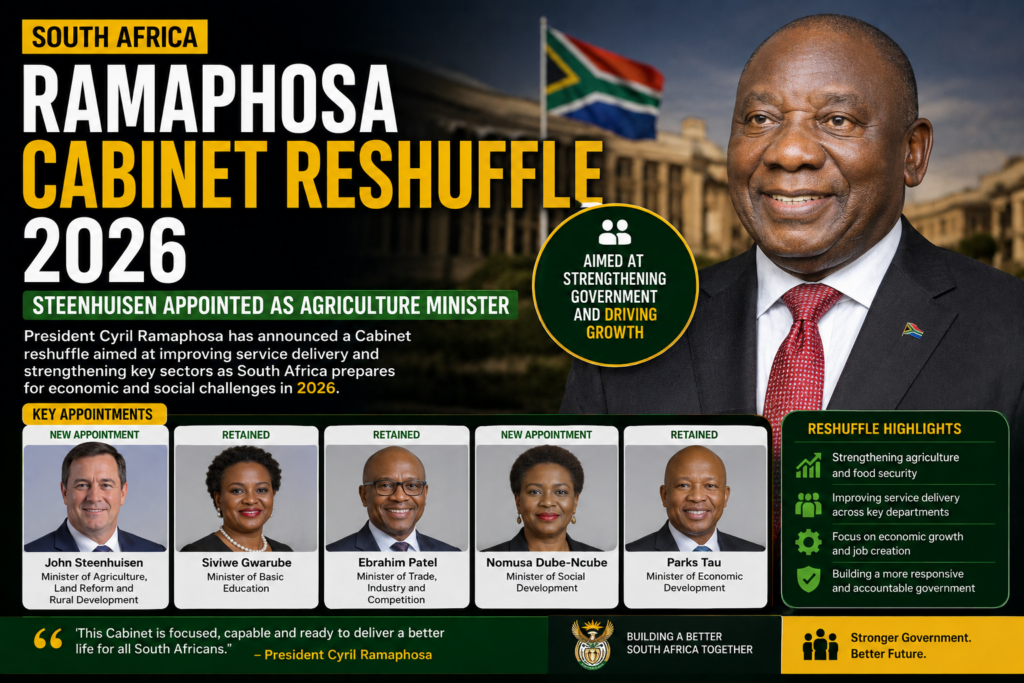
President Cyril Ramaphosa has reshuffled several portfolios in his Government of National Unity (GNU) cabinet, moving Democratic Alliance (DA) leader John Steenhuisen off the Agriculture portfolio he has held since the coalition government was formed in 2024. The changes, confirmed in the first days of July 2026, touch agriculture, trade, and environmental affairs, and land at a politically sensitive moment less than four months before local government elections.
What actually changed
Steenhuisen has moved from Minister of Agriculture to Deputy Minister of Trade, Industry and Competition. Taking over Agriculture is Willie Aucamp, another DA MP. David Maynier, also DA, has been appointed Minister of Forestry, Fisheries and the Environment. The reshuffle also brought in new DA deputy ministers: Alexandra Abrahams in Electricity and Energy, Jack Bloom in Water and Sanitation, and Yusuf Cassim in Higher Education.
Because Agriculture, Forestry, Fisheries and the Environment portfolios are allocated to the DA under the GNU power-sharing arrangement, the reshuffle was managed within the party rather than dictated solely by the Presidency, though Ramaphosa retains the constitutional authority to appoint and reshuffle his cabinet.
Why Steenhuisen was moved
According to reporting from Moneyweb, IOL and other outlets, the change followed internal DA pressure, with new DA leader Geordin Hill-Lewis said to have pushed for Steenhuisen’s move after criticism of his handling of a foot-and-mouth disease outbreak that disrupted livestock exports and rattled the red meat industry earlier in 2026. Steenhuisen has not lost his cabinet seniority in the same sense as being dropped entirely — a move to Deputy Minister of Trade, Industry and Competition keeps him inside government, just off the portfolio that had drawn the most public criticism.
Neither the Presidency nor the DA has framed this publicly as a demotion in the traditional sense, but commentators have noted that moving from a full ministry to a deputy ministry is, in practical terms, a step down in rank and public profile.
Who the change affects
- Farmers and the agricultural sector, who now deal with a new minister, Willie Aucamp, at a time when animal disease control, export markets and land policy all remain live issues.
- Environmental and fisheries stakeholders, who move under David Maynier’s newly combined Forestry, Fisheries and Environment portfolio.
- The DA itself, which now has to manage the optics of reshuffling one of its most recognisable MPs while presenting a united front within the coalition ahead of the November 2026 local government elections.
Background: the GNU’s portfolio-sharing arrangement
Since the African National Congress (ANC) lost its outright parliamentary majority in the May 2024 general election, it has governed in a multi-party Government of National Unity, with cabinet portfolios distributed among the ANC, DA and several smaller parties. Agriculture, Environment, Home Affairs and other departments were allocated to the DA as part of the coalition agreement. Internal party reshuffles within a shared portfolio, like this one, are a normal feature of coalition government, but they are watched closely for what they reveal about tension — or the lack of it — between coalition partners.
What happens next
Aucamp and Maynier are expected to formally take up their new responsibilities in the weeks following the announcement, with department officials briefing them on ongoing matters, including any lingering foot-and-mouth disease controls and export negotiations. Whether the reshuffle eases or deepens tension inside the GNU is likely to become clearer as the parties campaign separately — but govern jointly — ahead of the local elections expected between November 2026 and January 2027. For a broader look at whether the coalition can hold together through that vote, see our analysis, Can the GNU Survive an Election It’s Afraid to Lose?
How cabinet reshuffles actually work in South Africa
Under the Constitution, the President has the authority to appoint and dismiss members of the national executive, including ministers and deputy ministers, at his discretion. In an ordinary majority government, this power is exercised largely without needing to consult other parties. Inside a coalition arrangement like the GNU, that constitutional power sits alongside a political reality: portfolios understood to be “allocated” to a particular coalition partner are, in practice, filled and reshuffled with that party’s input, even though the President retains the final say. This reshuffle illustrates the distinction clearly — Ramaphosa formally made the appointments, but the personnel decisions within the DA-held portfolios appear to have been driven substantially by the DA’s own internal leadership process.
This dual-track system, part constitutional authority and part coalition convention, has no long history of precedent in South Africa, since the country had not previously been governed by a multi-party national coalition of this scale. Each reshuffle since the GNU’s formation in 2024 has, in effect, been adding to that precedent in real time.
The agriculture portfolio’s recent difficulties
Agriculture has not been an easy portfolio to hold over the past year. A foot-and-mouth disease outbreak disrupted livestock movement controls and rattled export markets for red meat products, forcing exporters to navigate additional certification and market-access hurdles at a time when several international markets already apply strict biosecurity conditions to South African livestock products. Handling an animal disease outbreak well requires close coordination between national government, provincial veterinary services and the private sector — coordination that becomes harder to sustain smoothly when it draws sustained public criticism of the minister responsible, as reporting suggests happened here.
Whoever holds the Agriculture portfolio going forward will need to manage not only the immediate disease-control response but also the longer-term work of rebuilding confidence among trading partners and the domestic livestock industry that South Africa’s biosecurity systems are being properly enforced.
How this reshuffle compares with past GNU personnel changes
Since the coalition’s formation, most personnel changes within DA-held portfolios have followed a broadly similar pattern to this one: managed internally by the party, announced jointly with the Presidency, and framed publicly as routine rather than as a sign of coalition strain. Whether that framing holds up depends partly on how smoothly the incoming ministers settle into their new roles, and partly on whether similar internal changes recur with a frequency that starts to look less like routine management and more like a pattern of underperformance being managed quietly rather than addressed head-on.
Frequently asked questions
Did Ramaphosa fire Steenhuisen?
No. Steenhuisen remains part of the executive as Deputy Minister of Trade, Industry and Competition. He was moved out of the Agriculture portfolio, not removed from cabinet.
Does this change affect the DA’s position in the GNU?
Not directly — the DA still holds the same category of allocated portfolios. The reshuffle was reported as an internal DA personnel decision made within the coalition framework, rather than a renegotiation of the GNU agreement itself.
Who decides which party gets which cabinet portfolio in the GNU?
Portfolio allocation was negotiated as part of the original GNU coalition agreement following the 2024 election. The President retains the constitutional authority to appoint individuals to those portfolios, but by convention has generally worked within the party allocations agreed when the coalition was formed.
Could this reshuffle happen again before the 2026 local elections?
Coalition governments generally reserve the right to reshuffle cabinet at any point, and further changes are possible, particularly if political pressure builds within any coalition partner ahead of a major election.
Sources Used
- Moneyweb — cabinet reshuffle coverage
- IOL — deputy minister appointments
- Farmer's Weekly — Aucamp agriculture portfolio
- The Citizen — GNU reshuffle confirmation
- Xinhua — cabinet changes reporting