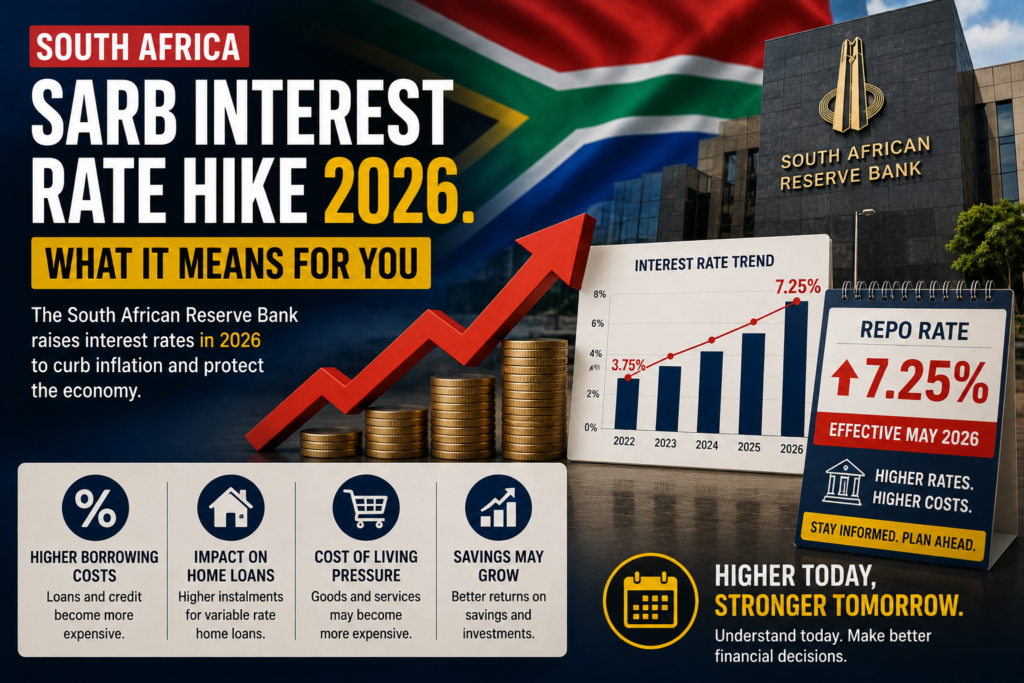
The South African Reserve Bank’s Monetary Policy Committee (MPC) raised the repo rate by 25 basis points to 7.00% on 28 May 2026 — its first interest rate hike since 2023. The decision, taken on a 4-2 vote, immediately pushed South Africa’s prime lending rate higher, adding to monthly repayments on bonds, car finance and other variable-rate debt for millions of consumers.
What the Reserve Bank decided, and why
The MPC’s decision was described as pre-emptive — a move to get ahead of building inflation pressure rather than a reaction to inflation that had already breached the Bank’s target range. That pressure was visible in the inflation data released around the same period: annual CPI inflation rose to 4.5% in May 2026, the third consecutive monthly increase, driven substantially by transport costs (fuel pass-through) and rising housing and utility costs linked to Eskom’s tariff increases. For the fuller inflation picture, see our report on May 2026’s inflation figures.
A 4-2 vote signals a genuine split within the MPC over how aggressively to respond to inflation risk, rather than a unanimous, clear-cut decision — a detail worth noting for anyone trying to predict the Bank’s next move.
How the repo rate affects your repayments
The repo rate is the rate at which the Reserve Bank lends to commercial banks, and it feeds directly into the prime lending rate that banks charge consumers — typically set a fixed margin above the repo rate. When the repo rate rises, banks generally raise prime accordingly, which increases the interest charged on variable-rate home loans, vehicle finance, personal loans and credit cards almost immediately.
- Home loans: a 25-basis-point increase adds a modest but real amount to monthly bond repayments — the exact rand impact depends on your outstanding loan balance and remaining term.
- Vehicle finance: similarly affected, particularly on newer finance agreements with longer remaining terms.
- Credit cards and personal loans: often priced at prime plus a margin, meaning these repayments rise too, generally with less delay than fixed-term products.
Borrowers on fixed-rate agreements are shielded from an immediate increase, but new fixed-rate deals are typically priced with the higher base rate factored in once it takes effect.
Why the Reserve Bank raises rates to fight inflation
Higher interest rates are meant to cool inflation by making borrowing more expensive and saving more attractive, which in theory reduces spending and eases upward pressure on prices over time. It’s a blunt tool — it affects every borrower with variable-rate debt, not just the specific sectors driving inflation — but it remains the Reserve Bank’s primary lever for keeping inflation within its target band, generally understood to sit around 3% to 6%.
What this means for the wider economy
Higher interest rates also raise borrowing costs for businesses, which can make companies more cautious about expansion and hiring — a dynamic that connects to the formal job losses reported in the same period; see South Africa’s formal job losses in early 2026. The Reserve Bank’s mandate is focused on price stability rather than employment directly, meaning it can raise rates even when doing so carries a cost to growth and jobs, if it judges that inflation risk requires it.
What happens next
A further MPC decision was expected in the second half of July 2026, with economists divided between a hold at 7% and a further hike, depending largely on where June’s inflation figure lands. Anyone with variable-rate debt should budget for the possibility of further rate movement rather than assuming May’s hike was a one-off adjustment.
What a “pre-emptive” hike signals about the Reserve Bank’s thinking
Central banks generally have two broad approaches available when responding to inflation risk: react once inflation has clearly breached target, or move earlier based on forward-looking indicators that suggest inflation is likely to rise, even if it hasn’t yet done so decisively. The Reserve Bank’s description of this hike as pre-emptive suggests the MPC majority judged that waiting for confirmed inflation data would have meant acting too late to prevent inflation expectations becoming embedded — a phenomenon where businesses and workers start pricing in higher future inflation, which can then become self-fulfilling through wage and price-setting behaviour. Critics of pre-emptive rate hikes argue they risk unnecessarily slowing growth and job creation in response to inflation risk that might not have materialised; supporters argue that inflation, once embedded in expectations, becomes considerably harder and more costly to bring back under control.
Who is affected most by rate increases
Interest rate increases do not affect all South Africans equally. Households with significant variable-rate debt — bonds, vehicle finance, credit cards — feel the impact directly and relatively quickly. Renters without significant debt may feel a more indirect effect, for example if landlords with bonded properties pass increased costs through to rental prices over time. Savers, by contrast, can benefit from higher rates, since banks typically also raise the interest paid on savings and fixed deposit accounts when the repo rate rises, though usually by a smaller margin than the increase in lending rates.
What to do if a rate hike affects your repayments
- Review your bond and vehicle finance agreements to confirm whether you’re on a variable or fixed rate, since only variable-rate agreements are directly affected by an MPC decision.
- Contact your bank proactively if a rate increase creates genuine affordability strain — restructuring options are usually easier to arrange before a payment is missed than after.
- Avoid taking on new variable-rate debt immediately after a hike without budgeting for the possibility of further increases, given the split MPC vote signalling continued uncertainty about the rate path ahead.
How South Africa’s rate compares regionally
South Africa’s 7% repo rate sits within a broadly comparable range to several other middle-income economies managing similar inflation and currency pressures, though direct comparisons are complicated by differences in each country’s specific inflation targets, currency stability and fiscal position. What matters most for South African borrowers is less how the rate compares internationally and more how it compares with their own borrowing costs over recent years, and whether further increases are likely given the inflation trend discussed in our related coverage.
How the MPC’s composition shapes its decisions
The Monetary Policy Committee is made up of Reserve Bank officials with different areas of expertise and, at times, differing views on the appropriate balance between controlling inflation and supporting growth. A 4-2 vote, rather than unanimity, is a useful reminder that monetary policy decisions of this kind are not mechanical calculations but judgment calls made by a committee weighing genuinely competing considerations, which is part of why financial markets watch the vote breakdown, not just the headline decision, for clues about the likely direction of future policy.
Frequently asked questions
What is the difference between the repo rate and the prime rate?
The repo rate is what the Reserve Bank charges commercial banks to borrow; the prime rate is what those banks then charge consumers, typically set at a fixed margin above the repo rate. When the repo rate moves, prime generally moves with it.
How often does the Reserve Bank review interest rates?
The Monetary Policy Committee meets several times a year on a published schedule to review and decide on the repo rate, based on the latest inflation and economic data available at each meeting.
Sources Used
- News24 — 'Reserve Bank pulls the trigger on interest rates'
- SAnews.gov.za — MPC rate decision coverage
- South African Reserve Bank — Monetary Policy Committee statement, May 2026