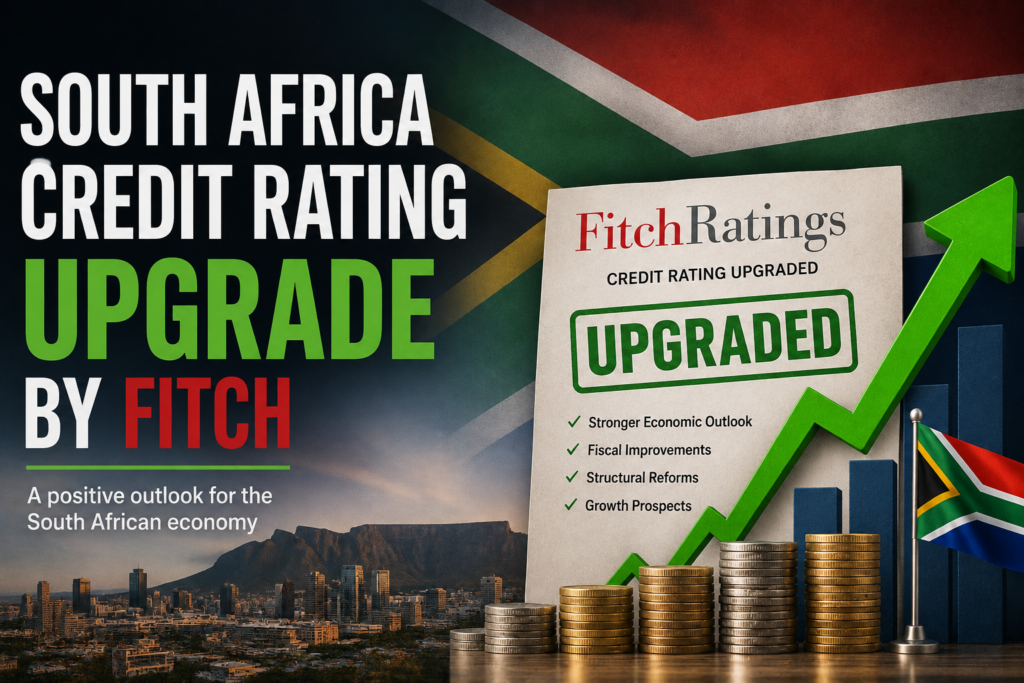
Fitch Ratings upgraded South Africa’s long-term foreign and local currency credit rating to BB from BB-minus on 5 June 2026 — the first upgrade from the agency in roughly 21 years. Fitch cited prudent fiscal management, a shift from budget deficits to primary surpluses, improved tax revenue collection and progress on energy and logistics reforms as reasons for the move.
What a credit rating actually measures
A sovereign credit rating is an assessment, produced by agencies such as Fitch, Moody’s and S&P Global, of how likely a government is to repay its debts in full and on time. Ratings are typically expressed on a letter-grade scale, with higher grades signalling lower perceived risk to lenders. South Africa’s BB rating from Fitch still sits below “investment grade” — commonly considered to begin around BBB-minus — meaning the country remains rated speculative or “junk” grade even after this upgrade, but the direction of travel matters as much as the current letter grade itself.
Why Fitch upgraded South Africa
Fitch’s stated reasons track closely with recent fiscal and reform developments covered elsewhere on Newsdomain: the 2026 Budget’s shift toward fiscal discipline, including a primary budget surplus and a debt-to-GDP ratio now projected to stabilise rather than keep climbing — see our recap of the 2026 Budget’s key numbers. Improved revenue collection by SARS and progress on structural reforms under the government’s Operation Vulindlela programme, particularly in energy and freight rail, were also cited as contributing factors.
Moody’s also moved — but more cautiously
Around three weeks before the Fitch decision, Moody’s affirmed South Africa’s Ba2 rating but revised its outlook from stable to positive — the first positive outlook shift from Moody’s since 2007. An outlook change signals the agency’s expectation of the likely direction for a future rating decision, without changing the rating itself immediately. Moody’s flagged continuing concerns, including South Africa’s low growth potential, weak labour market and fragile infrastructure, alongside the more positive fiscal signals. Separately, S&P Global had already upgraded South Africa to BB (foreign currency) and BB+ (local currency), both with a positive outlook, in November 2025.
Why this matters for ordinary South Africans
Credit ratings affect the interest rate at which government can borrow money on international and domestic markets. A better rating generally means government can borrow more cheaply, freeing up budget that would otherwise go toward debt-servicing costs for other priorities, such as health, education and infrastructure. It can also influence how private companies and banks are able to borrow, since sovereign ratings often set a rough ceiling for how favourably domestic companies can be rated. None of this translates into an immediate, visible change for most households, but it feeds into the government’s fiscal capacity over time — the same fiscal capacity that determines whether spending on services can grow, hold steady, or needs to be cut.
What still concerns the ratings agencies
Despite the upgrades, all three major agencies continue to flag structural weaknesses: persistently low economic growth, an unemployment rate above 32% — see our report on the latest unemployment figures — and infrastructure fragility, including the water and electricity challenges Newsdomain has covered separately. A ratings upgrade reflects improving trend and direction, not a declaration that these underlying problems have been solved.
Background: South Africa’s ratings history
South Africa lost its investment-grade rating from the major agencies through a series of downgrades in the mid-to-late 2010s, driven by concerns over state-owned enterprise governance, weak growth and rising debt. Since then, the country has been rated sub-investment grade (“junk”) by all three major agencies, making this run of upgrades — Fitch’s first in around two decades — a notable, if partial, reversal of that longer trend.
What happens next
Ratings agencies typically review sovereign ratings on a scheduled cycle, incorporating new fiscal data, growth figures and reform progress at each review. Whether South Africa can build on this momentum toward an eventual return to investment grade will depend heavily on sustained fiscal discipline and whether growth and employment outcomes — the areas agencies still flag as weak — begin to improve alongside the fiscal picture.
How the three major ratings agencies differ
Fitch, Moody’s and S&P Global each use their own rating scales and methodologies, meaning a rating from one agency isn’t always numerically identical to another agency’s rating for the same country, even when both are assessing broadly the same underlying risk. This is why South Africa’s ratings picture in 2026 looks slightly different depending on which agency’s assessment is being cited — Fitch’s BB, Moody’s Ba2 with a positive outlook, and S&P’s BB/BB+ with a positive outlook are all broadly consistent in direction (improving, still sub-investment grade) even though the specific letter and number designations differ between agencies.
What would be required to reach investment grade again
Returning to investment grade — last held by South Africa in the mid-2010s before a series of downgrades — would likely require sustained multi-year progress across several fronts simultaneously: continued fiscal discipline and debt stabilisation, meaningfully faster economic growth than the roughly 1.8% average currently projected by Treasury, and further progress on structural reforms addressing electricity, freight rail and logistics constraints. Ratings agencies have been explicit that isolated positive developments, however welcome, are unlikely to be suffient on their own; they are typically looking for a consistent, multi-year trend across fiscal, growth and structural reform indicators together before considering a return to investment grade.
How ratings changes affect the rand and financial markets
Sovereign ratings decisions can influence how international investors view South African assets, including government bonds and, to some extent, the currency. A ratings upgrade can support increased foreign investment interest, which in turn can contribute to a stronger or more stable rand over time — though currency movements are influenced by many other factors simultaneously, including global interest rate trends and commodity prices, making it difficult to attribute any single currency movement to a ratings decision in isolation.
Why ratings decisions are watched even by people who don’t invest directly
Even South Africans with no direct exposure to government bonds are indirectly affected by sovereign ratings, since government borrowing costs influence the overall interest rate environment and the fiscal room available for public spending on services like health, education and infrastructure that virtually everyone relies on in some form. A ratings upgrade is, in that sense, a signal worth tracking as a proxy for the country’s broader fiscal and economic trajectory, even for readers who will never buy a government bond themselves.
Frequently asked questions
Is South Africa still “junk status” after this upgrade?
Yes. A BB rating from Fitch remains below the BBB-minus threshold generally considered investment grade, meaning South Africa is still rated sub-investment grade despite the upgrade.
Does a credit rating upgrade lower my personal interest rates?
Not directly — your bond or loan interest rate is set mainly by the Reserve Bank’s repo rate and your bank’s own pricing, covered in our report on the SARB’s May 2026 rate hike. A sovereign credit upgrade can, over time, support lower government borrowing costs and a more stable economic environment, but it doesn’t automatically change consumer lending rates.
Sources Used
- Fitch Ratings, via Business Day and Daily Maverick — South Africa rating upgrade coverage, June 2026
- Daily Maverick — Moody's outlook revision reporting, May 2026
- National Treasury — Budget Review 2026 fiscal data