
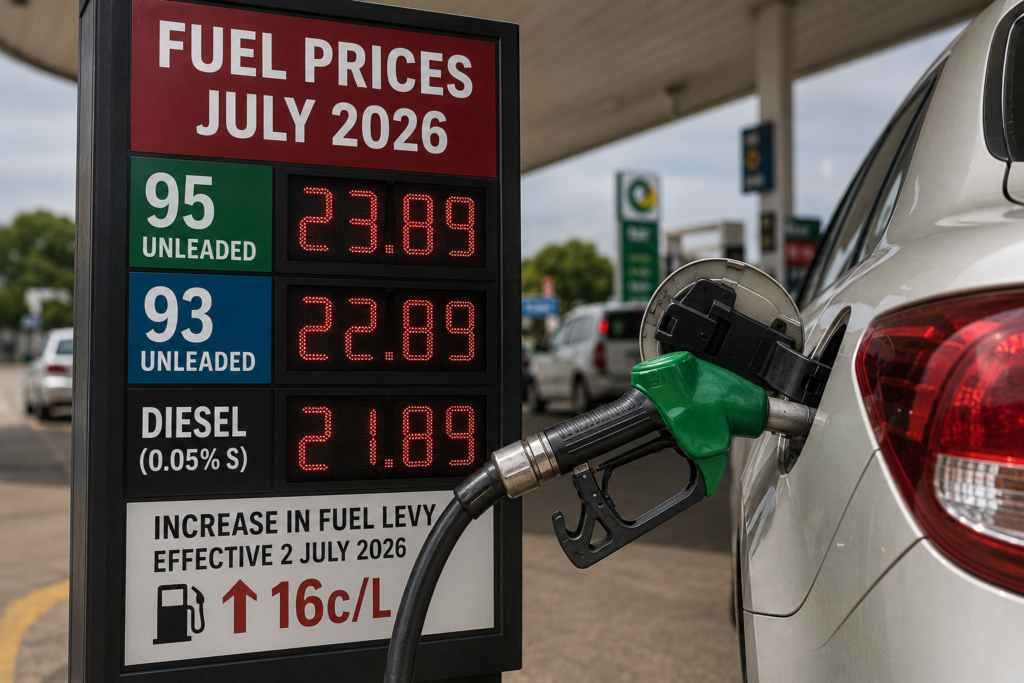
Petrol and diesel prices dropped sharply from 1 July 2026, with 93-octane petrol down R2.01 a litre and 95-octane down R1.96 a litre, driven mainly by falling global oil prices after a US-Iran de-escalation reduced fears of disruption to shipping through the Strait of Hormuz. But the same price adjustment also saw government reinstate the remaining half of the General Fuel Levy, which had previously been phased back — a move that quietly offset some of the relief motorists would otherwise have felt.
What changed at the pump
Brent crude oil fell from roughly $104.59 to $86.53 a barrel over the relevant pricing period, alongside a stronger rand, both of which fed through into July’s lower fuel prices. From 1 July 2026, 95 Unleaded petrol cost R25.23 a litre at the coast and R26.11 a litre in Gauteng; 93 Unleaded cost R25.94 a litre in Gauteng. Diesel prices dropped by an even larger margin than petrol over the same period.
The catch: the fuel levy came back
At the same time as the oil-price-driven relief, government reinstated the remaining half of the General Fuel Levy that had previously been phased back — adding roughly R1.50 a litre in tax on petrol and R1.96 a litre on diesel. Because this happened simultaneously with the larger oil-price-driven decrease, the net effect at the pump was still a price drop overall, but a smaller one than global oil price movements alone would have delivered. In effect, part of the relief motorists were expecting from falling oil prices was captured by government through the reinstated levy instead.
Why the fuel levy matters structurally
The General Fuel Levy is a fixed tax charged per litre of fuel sold, distinct from VAT and separate from the underlying wholesale cost of the fuel itself. Because it’s a flat per-litre charge rather than a percentage, it doesn’t fall when oil prices fall — meaning that once reinstated, it becomes a permanent, structural addition to the pump price going forward, not a one-off adjustment tied to this particular month’s price movement. This is a similar dynamic to South Africa’s now-abandoned Gauteng e-toll system, where funding mechanisms for road infrastructure have repeatedly run into public resistance — see our report on the scrapping of historical Gauteng e-toll debt.
What this means for household budgets
Fuel costs ripple through the wider economy well beyond what motorists pay directly at the pump — transport costs feed into the price of groceries, delivered goods and public transport fares, making fuel price movements one of the more consequential inputs into South Africa’s overall inflation rate. Our report on May 2026’s inflation figures showed transport as the single largest contributor to that month’s inflation increase, underscoring how closely fuel and general cost-of-living pressures are linked.
- July’s net price movement was a decrease, so motorists did see lower prices at the pump compared to June.
- The reinstated fuel levy means future oil price declines may not translate into proportionally equivalent pump price decreases, since a larger fixed tax component is now built into the price.
- Diesel users, including transport and logistics operators, saw a larger cent-per-litre decrease than petrol users this cycle, though also face the reinstated diesel levy portion.
Background: how South African fuel prices are set
South Africa’s fuel prices are set monthly by the Department of Mineral Resources and Energy using a regulated pricing formula that accounts for international product prices (petrol and diesel are priced off international benchmarks, not just crude oil), the rand exchange rate, transport and storage costs, and taxes including the General Fuel Levy and the Road Accident Fund levy. This formula-driven approach means South African pump prices can move for reasons unrelated to domestic policy — like global oil markets and currency movements — as well as reasons that are entirely domestic, like the levy decision reflected in this month’s price change.
What happens next
Fuel prices are reviewed and adjusted monthly, meaning August’s price will reflect whatever combination of oil price movements, currency shifts and tax settings apply at that point. With the fuel levy now reinstated in full, future price relief from falling global oil prices is likely to show up more directly at the pump than it did this month, since there is no further levy phase-back left to offset it.
How much of the pump price is actually tax
A substantial portion of South Africa’s regulated fuel price is made up of taxes and levies rather than the underlying cost of the fuel itself — including the General Fuel Levy, the Road Accident Fund levy, and various smaller regulated margins covering transport, storage and retail costs. With the General Fuel Levy now fully reinstated, the tax component of the pump price has returned to its previous, higher share of the total, meaning international oil price movements now translate somewhat less directly into pump price changes than they would if the levy portion were smaller.
Why the Road Accident Fund levy is a separate ongoing cost
Beyond the General Fuel Levy, South African motorists also pay a Road Accident Fund (RAF) levy on every litre of fuel purchased, which funds compensation for people injured or the dependants of people killed in road accidents. The RAF has faced its own long-running financial sustainability challenges, with its liabilities for future claims frequently reported as exceeding the fund’s assets by a significant margin — a structural issue distinct from, but related to, the broader debate over how road-related costs in South Africa should be funded and by whom.
How South African fuel prices compare internationally
South Africa’s fuel prices sit in the middle of the global range when compared with other countries — considerably higher than fuel-producing nations that subsidise domestic prices, but generally lower than many European countries, where fuel taxes are typically even higher as a share of the pump price. This comparison offers useful context but no direct policy guidance, since each country’s fuel pricing reflects a different mix of production costs, subsidy policy and taxation priorities.
What determines your household’s actual fuel cost exposure
How much a fuel price change affects any individual household depends heavily on personal circumstances — commute distance, vehicle fuel efficiency, and reliance on private transport versus public transport or walking. Households with minimal direct fuel exposure still feel fuel price movements indirectly, since transport costs are embedded in the price of almost every delivered good and service, meaning even non-drivers experience fuel price changes through their effect on the broader cost of living.
Frequently asked questions
Why did the fuel levy go up at the same time prices fell?
Government had previously phased back part of the General Fuel Levy; the remaining half was reinstated from 1 July 2026, a separate policy decision that happened to coincide with a larger oil-price-driven decrease, resulting in an overall net decrease despite the added tax.
How often do fuel prices change in South Africa?
Fuel prices are typically reviewed and adjusted on the first Wednesday of each month, based on a regulated pricing formula that accounts for international product prices, the exchange rate and local taxes and levies.
Sources Used
- Moneyweb — 'July fuel prices: Petrol drops by R2, diesel by over R3'
- IOL — July fuel price update coverage
- BusinessTech — official July 2026 petrol price reporting
- Cars.co.za — 'Fuel price July 2026: massive relief for SA motorists despite tax hike'