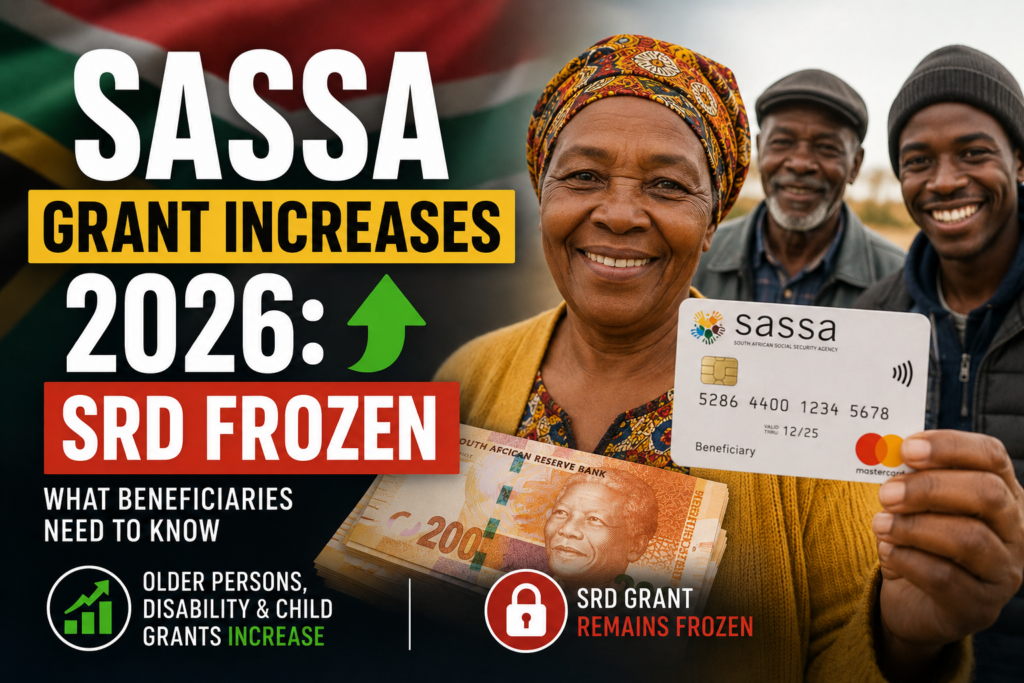
SASSA’s permanent social grants rose by 3.4% from 1 April 2026, with the Older Person’s, Disability and Care Dependency grants increasing by R80 to R2,400 a month for recipients aged 60 to 74. But the R370 Social Relief of Distress (SRD) grant — relied on by millions of unemployed South Africans with no other income — remains unchanged for a third consecutive year, despite repeated calls to raise it closer to the food poverty line.
What increased, and by how much
- Older Person’s, Disability and Care Dependency grants (ages 60–74): up R80 to R2,400 a month.
- Older Person’s Grant (ages 75+): up to R2,420 a month.
- War Veterans Grant: up to R2,420 a month.
- Child Support Grant: up from R560 to R580 a month.
- Grant-in-Aid: up to R580 a month.
The 3.4% increase applied to these permanent grants is lower than the roughly 4.8% increase granted the previous year, reflecting a more constrained fiscal environment even as the increases remained above the recorded inflation rate for the same period.
The SRD grant: frozen again
The Social Relief of Distress grant, introduced as a temporary COVID-era measure and repeatedly extended since, remains at R370 a month for a third year running. Civil society organisations and some economists have argued the amount should rise toward the food poverty line — the minimum monthly amount Stats SA estimates is needed to meet basic food needs, set at R624 per person by recent measurement — but government held the amount flat in the 2026 Budget while allocating an additional R36.4 billion to extend SRD payments through to 31 March 2027.
In real terms, a frozen grant amount during a period of rising inflation — covered in our report on May 2026’s inflation figures — represents a cut in purchasing power for the millions of recipients who rely on it, even though the nominal rand amount hasn’t changed.
Why the difference between grant types matters
The gap between permanent grants receiving above-inflation increases and the SRD grant remaining frozen reflects a fundamental design difference: permanent grants like the Older Person’s and Disability grants are enshrined in longer-standing social security legislation, while the SRD grant remains, technically, a temporary relief measure repeatedly extended rather than a permanent feature of South Africa’s social security system. This distinction matters for anyone hoping the SRD grant might eventually convert into a permanent Basic Income Support grant — a Basic Income Support white paper is reportedly expected from government before the end of 2026, which would set out a longer-term policy direction.
SASSA is also tightening fraud checks
Alongside the increases, SASSA has said it is tightening eligibility and fraud checks across its grant book, which means some recipients may face additional verification requirements or, in cases of confirmed ineligibility, the loss of a grant they had been receiving. Anyone whose grant status changes unexpectedly should follow up directly with SASSA to understand the reason and their right to query or appeal the decision.
What this means for grant recipients
- Recipients of permanent grants should see the new amounts reflected from their April 2026 payment onward.
- SRD grant recipients should not expect an increase in the R370 amount, though the grant itself has been extended and remains available through to March 2027 under current government plans.
- Anyone facing new verification requests from SASSA should respond promptly with the requested documentation to avoid payment interruption.
Background: 26.5 million people rely on this system
South Africa’s social grant system, administered by SASSA, reaches an estimated 26.5 million beneficiaries — making it one of the largest social protection programmes on the continent, and a central pillar of government’s approach to reducing poverty in a country with an official unemployment rate above 32%, covered in our report on the latest unemployment figures.
What happens next
The promised Basic Income Support white paper, if released before the end of 2026 as reportedly planned, would be the clearest signal yet of whether government intends to convert the SRD grant into a permanent feature of South Africa’s social security system, and at what level it might eventually be set.
Why South Africa’s grant system uses different rules for different grants
The distinction between grants that received above-inflation increases and the frozen SRD grant reflects deeper differences in how each grant is governed. Permanent grants such as the Older Person’s and Disability grants are provided for under the Social Assistance Act, with a long-established review and adjustment process built into the annual budget cycle. The SRD grant, by contrast, was introduced through a series of regulations issued under emergency and subsequent extension provisions, without the same permanent legislative footing — which is precisely why its future, including whether it becomes a permanent Basic Income Support grant, remains an open policy question rather than a settled matter.
The debate over converting SRD into permanent Basic Income Support
Advocates for converting the SRD grant into a permanent, adequately funded Basic Income Support grant argue that with unemployment above 32%, a temporary relief measure repeatedly extended year after year has, in practice, become a de facto permanent feature of South Africa’s social safety net — and that its governance and funding should reflect that reality rather than continuing to be treated as an emergency measure. Sceptics, including some voices within Treasury, have raised concerns about the long-term fiscal sustainability of a permanent, adequately funded basic income grant given South Africa’s already-stretched budget and debt position — concerns that connect directly to the broader fiscal picture discussed in our budget recap, the 2026 Budget’s key numbers. The promised white paper is expected to be the government’s most detailed attempt yet to resolve this tension.
How SASSA’s tightened fraud checks are being applied
SASSA has said it is using improved data-matching against other government and financial databases to verify continued eligibility, particularly for the SRD grant, where income and identity verification checks against employment and banking records have periodically flagged recipients whose circumstances may have changed since their last verification. Recipients who believe they’ve been incorrectly flagged have the right to query the decision and provide updated supporting documentation, though the process for doing so can take time to resolve.
What the increases mean in practical monthly terms
For a household relying on the Older Person’s Grant, an extra R80 a month provides some additional room in a monthly budget already stretched by rising transport, electricity and food costs — but set against May 2026’s reported 4.5% inflation rate, a 3.4% increase represents only a modest real-terms gain, and in some cost categories may not fully offset the increased cost of living experienced over the same period. This is the practical reality behind headline grant increase figures: nominal increases and real, inflation-adjusted increases can tell noticeably different stories about whether recipients are genuinely better off.
Frequently asked questions
Did the SRD grant increase in 2026?
No — the R370 monthly amount remained unchanged for a third consecutive year, though the grant itself was extended through to 31 March 2027.
Why did permanent grants increase but not the SRD grant?
Permanent grants are governed by longer-standing social security provisions and generally receive scheduled annual increases; the SRD grant remains a repeatedly extended temporary relief measure, which government has kept at a fixed amount despite calls to raise it.
Sources Used
- Department of Social Development — 2026 grant amount announcement
- SAnews.gov.za — SASSA grant increases coverage
- Daily Maverick — 'Grants grow, SRD extended and Sassa tightens checks to cut fraud'
- TimesLIVE — SASSA 2026 grant increase reporting