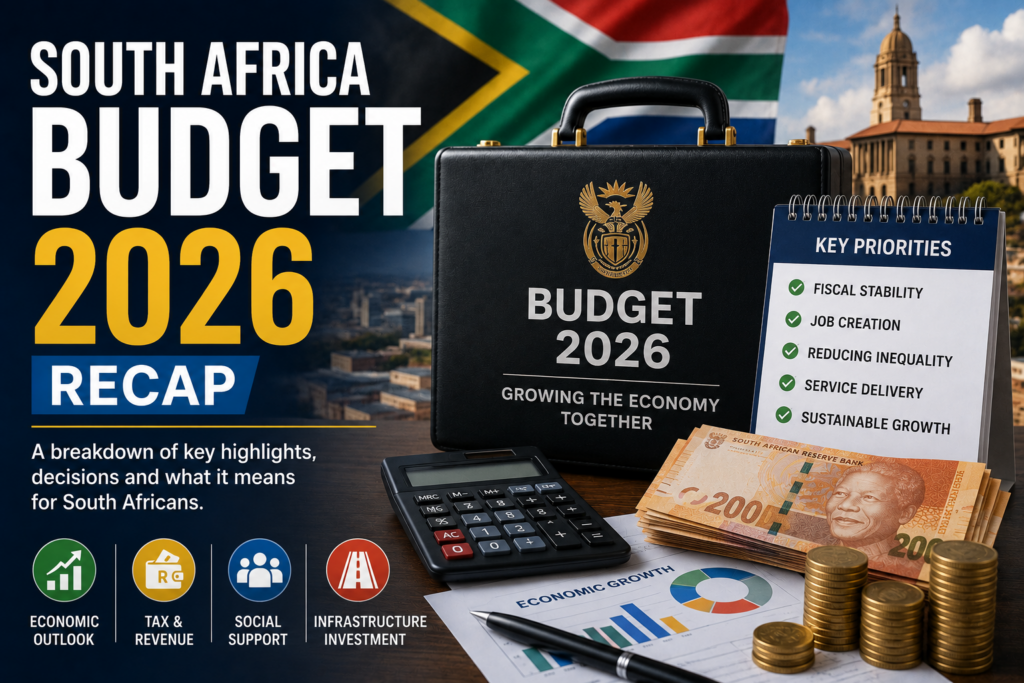
Finance Minister Enoch Godongwana delivered the 2026/27 National Budget on 25 February 2026, confirming that a previously proposed VAT increase to 17% would not go ahead — VAT remains at 15%. Government will spend R2.67 trillion in the 2026/27 financial year, with personal income tax brackets and medical tax credits fully adjusted for inflation for the first time in two years.
The headline decision: no VAT increase
A VAT increase of R20 billion, which would have taken the rate to 17%, had been pencilled into earlier budget planning but was ultimately withdrawn. For consumers, this means no additional VAT was added to the cost of everyday purchases — a meaningful relief given the cost-of-living pressures already visible in South Africa’s inflation data, covered in our report on May 2026’s inflation figures.
What else changed for taxpayers
Personal income tax brackets and medical tax credits were fully adjusted for inflation for the first time in two years. In practice, this means the tax brackets that determine how much tax you pay at each income level moved up in line with inflation, reducing the effect of “bracket creep” — where wage increases that merely keep pace with inflation can otherwise push taxpayers into higher tax brackets without any real increase in purchasing power. For the practical deadlines that follow from the new tax year, see our report on SARS’s 2026 Filing Season dates and deadlines.
Where the R2.67 trillion is going
According to the Budget Review, basic education, health and social protection together make up 70.3% of what Treasury describes as the “social wage” — spending directed at services and support for lower-income households — covering 13.6 million schoolchildren and 26.5 million grant beneficiaries. This concentration of spending reflects a budget built around maintaining core social services rather than large new spending programmes.
Relief for small businesses
The Budget also raised the compulsory VAT registration threshold for businesses to R2.3 million in annual turnover, and lifted the voluntary registration threshold from R50,000 to R120,000, both effective from 1 April 2026. This eases the compliance burden on small and micro businesses, allowing more of them to operate below the threshold that requires VAT registration, collection and reporting — a meaningful simplification for informal traders and small entrepreneurs.
What this means for grant recipients
Grant increases were confirmed as part of the same budget process, though not uniformly generous: permanent grants such as the Older Person’s and Disability grants received above-inflation increases, while the R370 Social Relief of Distress (SRD) grant remained frozen for a third consecutive year. For the detail on how this affects the millions of South Africans receiving grants, see our report on SASSA’s 2026 grant increases and the frozen SRD grant.
The fiscal backdrop
This budget was framed against an improving, though still fragile, fiscal position. South Africa’s debt-to-GDP ratio is projected to stabilise at around 77.9% before beginning to decline — the first time since the 2008 global financial crisis that government debt is expected to stop rising as a share of the economy. A primary budget surplus (revenue exceeding non-interest spending) of 0.9% was reported, with Treasury projecting this to rise to 2.5% over the following three years. This fiscal discipline has been cited by credit ratings agencies in recent decisions — see our report on South Africa’s credit rating upgrade by Fitch.
What happens next
The tax and spending decisions confirmed in February 2026 will play out through the rest of the financial year, with the Medium-Term Budget Policy Statement (MTBPS), typically delivered around October or November, expected to update these projections based on how revenue collection and spending track against the original plan.
Why withdrawing the VAT increase was a significant decision
VAT increases are politically difficult in almost any country, because they apply broadly across most goods and services and are felt immediately by every consumer, unlike more targeted tax changes. The fact that a planned VAT increase was withdrawn rather than implemented, even partially, suggests government judged the political and social cost — particularly amid already-elevated cost-of-living pressure — outweighed the additional revenue the increase would have raised. This required finding alternative ways to balance the budget, which is part of why the overall spending and revenue picture in this budget looked different from the version that had been under consideration when the VAT increase was still on the table.
How the budget process actually works
South Africa’s national budget is prepared by National Treasury and presented annually by the Finance Minister, typically in February, with a Medium-Term Budget Policy Statement (MTBPS) presented around October or November providing a mid-year update and revised projections. The budget must ultimately be approved by Parliament, and — under the current coalition government — that approval process has required negotiation among GNU partners in a way that was less necessary when a single party held an outright majority. This is part of why the VAT increase’s withdrawal was seen as significant beyond its direct fiscal impact: it reflected the practical reality of coalition government requiring genuine compromise on major budget decisions, not simply National Treasury’s preferred policy being implemented unilaterally.
What wasn’t addressed in this budget
Every budget involves trade-offs, and this one was no exception. Critics have pointed to areas that received comparatively modest attention relative to their scale as ongoing challenges — including further structural support for struggling state-owned enterprises beyond Eskom, and more decisive measures to accelerate economic growth beyond the modest rates currently projected. A budget that avoids a VAT increase and stabilises debt is, by most measures, a fiscally cautious document — which is a defensible choice given South Africa’s debt history, but one that leaves less room for the kind of large new spending initiatives that would address some of these other pressures directly.
How this budget affects different income groups
Lower-income households benefit most directly from the social wage spending — grants, health and basic education — that made up 70.3% of relevant spending categories, and from VAT remaining unchanged rather than rising. Middle-income taxpayers benefit from the inflation-adjusted tax brackets, which limit bracket creep. Small business owners benefit from the raised VAT registration thresholds. Higher-income earners and larger businesses see comparatively less direct benefit from this specific budget’s headline measures, though they remain affected by the same broader economic conditions — inflation, interest rates, growth — the budget is designed to help manage.
Why this budget was negotiated rather than simply announced
Under a coalition government, a national budget is less a unilateral Treasury decision and more the outcome of negotiation among GNU partners with differing priorities and political bases to answer to. The VAT increase’s withdrawal is the clearest visible evidence of that negotiation in this specific budget, but the underlying process — balancing competing coalition priorities against a constrained fiscal position — shaped decisions across the document, not only the headline VAT call.
Frequently asked questions
Did VAT go up in 2026?
No — a proposed increase to 17% was withdrawn, and VAT remained at 15%.
What is the “social wage” Treasury refers to?
It refers to the combined value of spending on basic education, health and social protection — services and support aimed primarily at lower-income households — which the 2026/27 Budget put at 70.3% of total spending in that category.
Sources Used
- National Treasury — Budget Review 2026
- SAnews.gov.za — Budget Speech coverage, February 2026