This is an opinion and analysis piece. It reflects the writer’s assessment of publicly available evidence and should be read as argument and analysis, not as a straight news report.
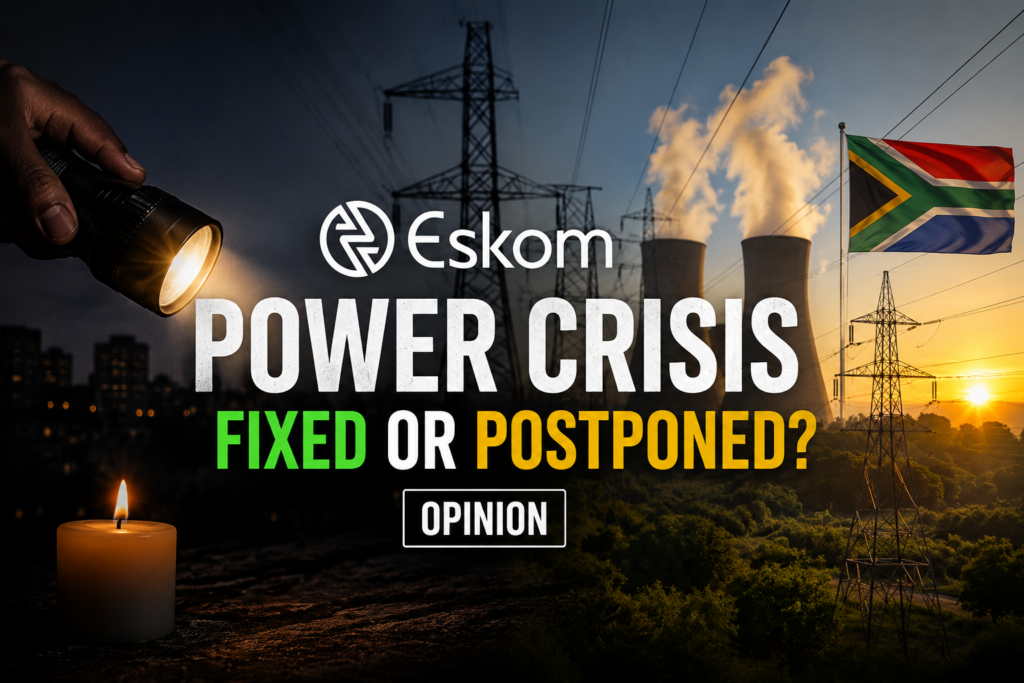
Eskom has now gone more than 400 consecutive days without load shedding — a fact worth genuine celebration for a country that spent the better part of a decade planning its life around rolling blackouts. But the more interesting question isn’t whether the lights are staying on right now. It’s whether South Africa has actually fixed the underlying problem, or simply bought itself a few good years before the same structural gap reappears.
The case that something real has changed
The numbers behind the current stability are not cosmetic. Eskom’s Energy Availability Factor — the share of its total generation fleet actually available to produce power — has climbed from 58.54% to 64.29% year-on-year for the same measurement period. Unplanned outages have fallen substantially, and the Unplanned Capacity Loss Factor has improved from around 31% to under 24%. These are the kinds of operational metrics that reflect changes in maintenance discipline and plant management, not luck. For the full data, see our report on Eskom’s 400 days without load shedding.
That is a genuine achievement, and it deserves to be described as one rather than dismissed as a temporary fluke.
The case for scepticism
But “more reliable operation of existing capacity” and “solved the structural energy problem” are two different things, and it’s worth being precise about which one South Africa has actually achieved. Eskom’s own Medium-Term System Adequacy Outlook — not an external critic’s assessment, but the utility’s own forward-looking analysis — reportedly warns that load shedding could return within three to four years if the current schedule for decommissioning ageing coal-fired power stations proceeds without enough new generation capacity coming online to replace it.
That is a striking admission. It means the organisation best positioned to know Eskom’s own future capacity position is telling South Africans, in its own planning documents, that the current stability has an expiry date attached to certain conditions.
Two things can be true at once
The tempting framing in public debate is binary: either Eskom has turned the corner, or the “good news” is a mirage. Neither framing is quite right. What the evidence actually supports is that Eskom has become significantly better at running the fleet it currently has — squeezing more reliable output from ageing infrastructure through improved maintenance — while doing comparatively little, so far, to solve the longer-term question of what replaces that ageing infrastructure as it is retired.
Running an old car well is a real skill, and it buys real time. It is not the same thing as buying a new car.
The cost side of the ledger
It’s also worth being honest that this reprieve has not been free. Tariff increases approved partly to fund Eskom’s operational turnaround have been a meaningful driver of South Africa’s recent inflation — housing and utilities costs rose 5.3% in the CPI data for May 2026, discussed in our report on May’s inflation figures. Households and businesses are, in a real sense, paying for the stability they’re currently experiencing, which is a legitimate trade-off but one that deserves to be named rather than left implicit in celebratory framing of the “days without load shedding” counter.
What would actually resolve the underlying tension
The honest answer is capacity — new generation, whether from renewables, gas, or other sources, coming online fast enough to offset the retirement of Eskom’s oldest coal fleet. Government’s own reform programme, Operation Vulindlela, has made some progress opening the electricity market to greater private participation, and utility-scale renewable projects have been reaching financial close through recent bid windows. Whether that pipeline moves fast enough to close the gap Eskom itself has flagged is, at the time of writing, genuinely unresolved — not a question either side of the debate can claim to have settled.
Where this leaves the debate
South Africans have earned the right to enjoy 400-plus days of reliable power without immediately being told to worry about the next crisis. But treating the current stability as a finished story, rather than a genuinely uncertain multi-year project with a utility-acknowledged risk window, would be a mistake — one that could leave the country as unprepared for the next capacity shortfall as it was for the last one.
Sources Used
- Eskom — Power System Status data and Medium-Term System Adequacy Outlook
- Daily Investor — 'Load shedding can come back in three years'
- gov.za — Eskom performance statements, 2026
What critics of the “fixed or delayed” framing get right and wrong
Some commentators have gone further than scepticism, arguing the entire “days without load shedding” narrative is close to meaningless, since it says nothing about underlying capacity risk. That framing goes too far in the other direction — the operational improvements behind the current stability are real and verifiable through Eskom’s own published performance data, not simply a public relations exercise. But commentators emphasising the multi-year risk window are right that “no load shedding today” and “the capacity problem is solved” are meaningfully different claims, and public and political discourse has, at times, blurred the two.
What South Africans should actually watch for
Rather than treating either the “crisis over” or “crisis merely delayed” framing as settled, a more useful approach for readers is to track two separate things over the coming years: Eskom’s ongoing operational performance data (EAF, unplanned outages), which indicates how well the existing fleet is being managed, and the pace of new generation capacity — from Eskom itself, private developers, and renewable energy projects — coming online relative to the retirement schedule of ageing coal plants. The first tells you whether today’s stability is holding; the second tells you whether tomorrow’s stability has a foundation being built under it.
The tariff trade-off deserves more scrutiny than it usually gets
Public debate tends to treat “reliable electricity” and “affordable electricity” as separate conversations, but they are directly linked through the tariff increases funding Eskom’s recovery. A more complete assessment of whether Eskom has genuinely “fixed” the crisis would weigh reliability gains against the affordability cost imposed to achieve them — a trade-off that has been under-examined relative to the attention given to the load-shedding-day counter itself.
A question worth asking of any “crisis solved” claim
Whenever a government or state entity declares a long-running crisis resolved, it’s worth asking a simple question: resolved according to what specific, measurable criteria, and over what time horizon? Eskom’s own documents suggest the honest answer, on its own terms, is “reliable today, uncertain beyond three to four years absent further action” — a considerably more qualified claim than the simpler “crisis over” framing that sometimes appears in public discussion of the load-shedding milestone.
A note on how to read Eskom’s own risk disclosures
When a state utility’s own forward planning documents flag risk, that disclosure deserves to be treated as a credible input to public debate, not dismissed as excessive caution or amplified into inevitability. Eskom has strong institutional incentive to overstate progress rather than understate it, which makes its own acknowledgment of medium-term risk a more, not less, credible signal worth taking seriously in any honest assessment of where the power system genuinely stands.