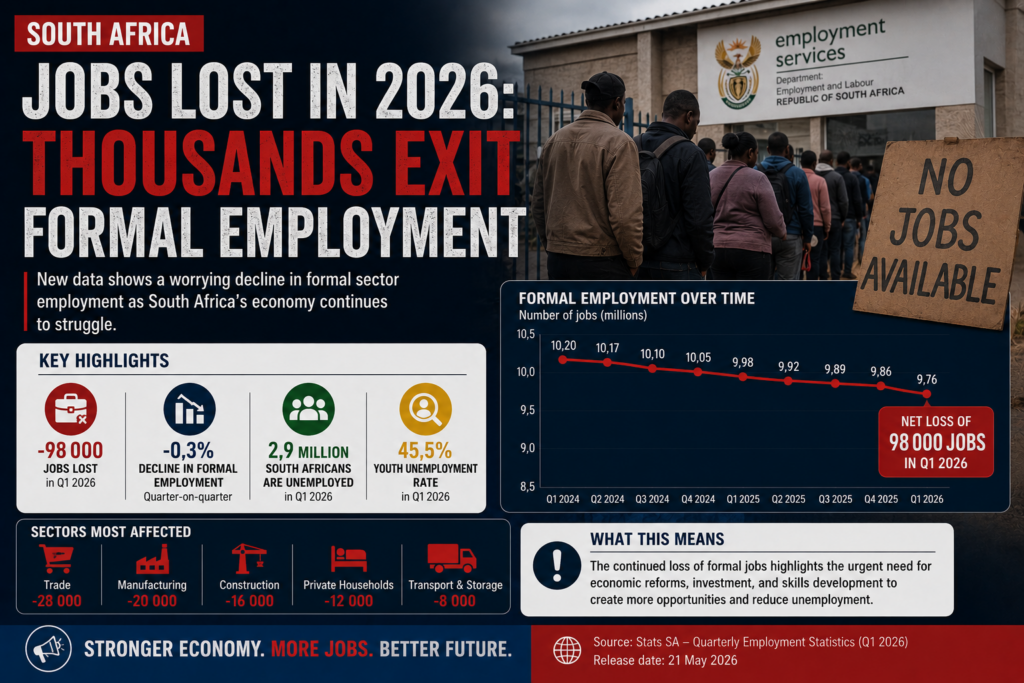
South Africa’s formal sector shed tens of thousands of jobs in the first quarter of 2026, according to the latest Quarterly Employment Statistics (QES) survey. Reporting on the release put the quarterly loss at roughly 80,000 jobs, with job losses over the preceding twelve months estimated at around 121,000 — a reminder that even as some headline economic indicators improve, the labour market is still shedding formal positions.
What the data shows
The QES survey, conducted by Statistics South Africa, tracks formal, non-agricultural employment by surveying employers directly, which makes it a different measure from the household-based Quarterly Labour Force Survey (QLFS) that produces the official unemployment rate. Where the QLFS asks individuals about their work status, the QES counts actual jobs on employer payrolls, and it’s this survey that recorded the drop reported in early July 2026.
Alongside falling formal employment, reporting on the release also pointed to a decline in wages and bonuses paid out over the quarter, suggesting that the pressure on the labour market was not limited to headcount alone.
Why formal jobs are disappearing
No single cause explains a jobs number like this — it’s the sum of thousands of individual hiring and firing decisions across the economy. But several pressures were visible in the same period:
- Sector-specific retrenchments, including manufacturing job losses tied to company-level restructuring — see our report on the NUMSA strike at First Battery over 165 retrenchments for one concrete example playing out in real time.
- Subdued overall growth. The economy has been expanding, but at a pace — averaging close to 2% — that economists generally regard as too slow to create enough new formal jobs to offset losses elsewhere.
- Cost pressures on employers, including borrowing costs that rose after the South African Reserve Bank’s rate hike earlier in the year, which can make businesses more cautious about hiring or retaining staff.
How this fits into the bigger unemployment picture
A falling formal-jobs count doesn’t map one-to-one onto the unemployment rate, because people who lose formal jobs sometimes find informal work, leave the labour force, or are offset by job creation elsewhere in the economy. But the two data sets tend to move in the same direction over time, and this release lands alongside an official unemployment rate that has also been climbing. For the fuller picture, see our report on South Africa’s unemployment rate rising to 32.7%.
What this means for workers
For anyone currently employed, a rising job-loss figure is a signal to take retrenchment risk seriously — reviewing your rights under the Labour Relations Act, understanding your UIF entitlement if you are retrenched, and keeping your CV and job-seeker registration up to date are all sensible precautions in a shrinking formal jobs market. For anyone newly unemployed, registering for UIF benefits as soon as possible after retrenchment is important, since delays in applying can delay payment.
What happens next
The next QES release will show whether the Q1 2026 losses were a blip or the start of a longer slide. Analysts will also be watching whether interest rate decisions, discussed in our coverage of the SARB’s interest rate hike, ease off enough over the coming quarters to support hiring, or whether continued restrictive policy adds further pressure to an already strained labour market.
How job losses ripple through the wider economy
A falling formal-employment count doesn’t stay contained to the people who lose their jobs directly. Retrenched workers typically cut discretionary spending immediately, which reduces revenue for the retailers, restaurants and service providers they would otherwise have supported — a knock-on effect economists sometimes call the multiplier impact of job losses. Municipalities also feel the effect indirectly, since a smaller pool of formally employed residents can mean slower growth in rates and services revenue over time, even though most municipal income comes from property rates and utility charges rather than income tax directly.
There is also a fiscal dimension. Every formal job lost is a job that was very likely contributing PAYE income tax and UIF contributions; its loss narrows the tax base at the same time as it potentially adds a new claimant to UIF and, eventually, to social grant support if unemployment persists. This is part of why labour market data is watched so closely by National Treasury and the Reserve Bank alongside more commonly cited indicators like inflation and GDP growth.
Putting the number in historical context
South Africa’s formal employment count has been on a broadly volatile path for years, shaped by global economic cycles, domestic policy shifts, and — more recently — the aftermath of pandemic-era job losses that took years to partially recover. A single quarter’s job losses, even a significant one, rarely tells the full story on its own; economists typically look for a sustained trend across two or more consecutive releases before treating a change as a genuine turning point rather than normal quarter-to-quarter volatility. That said, a loss of this scale, combined with a rising unemployment rate reported in the same period, is difficult to dismiss as pure noise.
What retrenched workers should do first
- Register a UIF claim as soon as possible after your last day of employment — delays in applying translate directly into delays in payment, since UIF benefits are not backdated indefinitely.
- Request a UI-19 form and final payslip from your employer, since these are typically required documents for a UIF claim.
- Update your job-seeker registration and CV promptly, since re-entering formal employment quickly is generally easier the sooner a job search begins after a retrenchment.
- Review any retrenchment package offered against the legal minimum severance entitlement of one week’s pay per completed year of service, and query it with your employer or a labour advisory service if it appears to fall short.
None of these steps undo a job loss, but they meaningfully affect how quickly a retrenched worker can access the financial support and re-employment opportunities available to them under South African law.
What to watch in the next release
A single quarter’s job losses can reflect temporary factors — seasonal hiring patterns, one-off restructuring events at a handful of large employers, or genuine broader weakness. The clearest signal will come from whether the next QES release shows losses continuing at a similar pace, stabilising, or reversing. Economists generally treat two or more consecutive quarters moving in the same direction as a more reliable indicator of an underlying trend than any single quarter viewed in isolation, however striking that single quarter’s number might look in a headline.
Frequently asked questions
Is this the same as the unemployment rate going up?
Not directly. The QES measures formal jobs on employer payrolls, while the unemployment rate comes from a separate household survey (the QLFS). They usually move in the same direction but are not interchangeable measures.
Which industries were hit hardest?
Reporting on the release did not provide a single, independently verified sector-by-sector breakdown consistent across all sources; readers wanting sector-level detail should consult the full Stats SA QES release directly at statssa.gov.za.
Sources Used
- Statistics South Africa — Quarterly Employment Statistics (QES), Q1 2026
- IOL — 'South Africa lost 80,000 jobs in three months'
- BusinessTech — job losses reporting
- Joburg ETC — Q1 2026 employment coverage