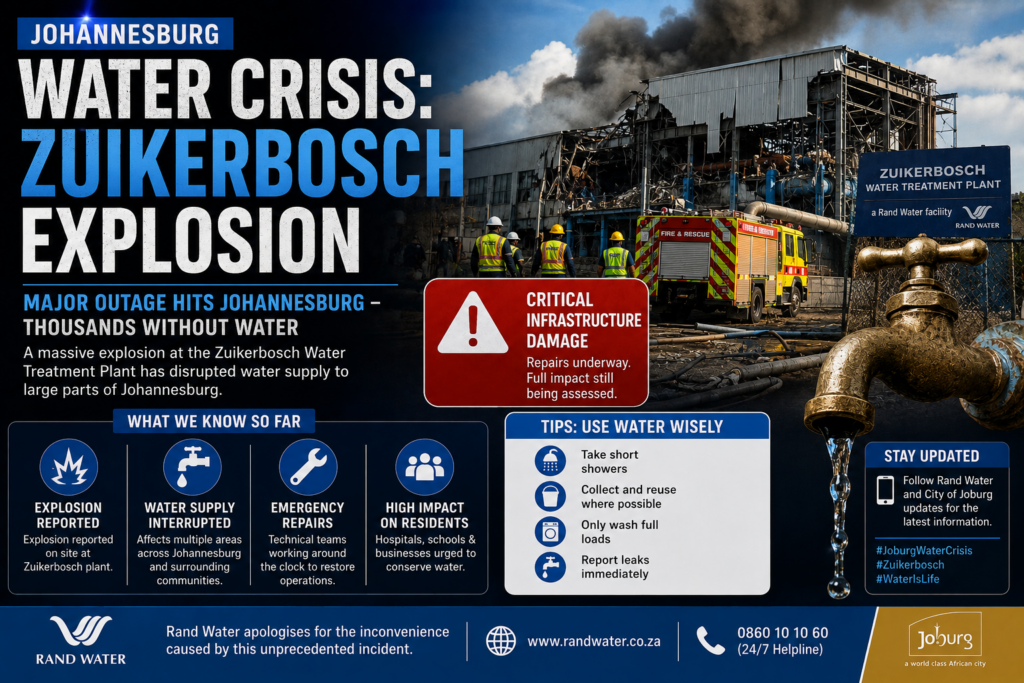
An electrical failure at Rand Water’s Eikenhof booster station in the early hours of Thursday, 16 July 2026, cut power to a pumping hub that feeds large parts of southern Johannesburg and several mining towns to the city’s west, draining reservoir levels and leaving many households and businesses without water for days. The incident has become the latest, and among the most severe, flashpoints in a water crisis that has been building in Johannesburg for years.
What happened at Eikenhof
According to reporting by News24, Moneyweb, Bloomberg and Engineering News, an explosion or major electrical failure struck the lines feeding the Eikenhof booster station at around 2am on 16 July. The booster station is a critical link in the system that moves water from Rand Water’s Zuikerbosch treatment works to reservoirs across southern Johannesburg. With the pumping hub down, levels dropped sharply at reservoirs including Meredale, Waterval, Roodepoort, Krugersdorp, Weltevreden, Witpoortjie, Libanon, Driefontein, Rustenburg and Barnardsvlei — a spread that illustrates how much of the region depends on a small number of critical pumping and treatment points.
Government convened a meeting to assess the impact on supply systems in the days following the incident, according to SAnews, underlining how seriously the disruption was treated at a national level, not just as a City of Johannesburg or Rand Water operational matter.
Why one power failure could cause such a widespread crisis
Johannesburg’s water network relies on a relatively small number of large treatment and pumping installations moving huge volumes of water across a sprawling metro and beyond. When a single critical node — like the Eikenhof booster station — goes down, there is often limited redundancy to immediately compensate, meaning reservoirs downstream begin to drop within hours, and the effects cascade to suburbs and towns that may be a considerable distance from the point of failure itself.
This incident did not occur in isolation. President Ramaphosa has separately acknowledged that ageing and poorly maintained municipal infrastructure — not a shortage of raw water itself — is the primary driver of South Africa’s broader water crisis, a point examined in more depth in our analysis, Joburg’s water crisis as a warning for every South African city.
Who was affected
- Residents across large parts of southern Johannesburg, including areas served by the affected reservoirs.
- Mining towns to the city’s west that draw on the same Rand Water supply network.
- Businesses and institutions in affected areas that rely on continuous municipal water supply for daily operations.
Recovery time varies significantly by location and elevation — areas at higher ground or further from the treatment works typically take longer to see supply restored, since gravity-fed systems refill low-lying reservoirs first.
What residents can do while supply is disrupted
- Check the City of Johannesburg and Rand Water’s official channels for area-specific restoration updates rather than relying on informal social media reports.
- Store water in advance where possible once early warning of planned or unplanned outages is issued.
- Report burst pipes or visible leaks promptly, since a strained system has less tolerance for additional losses during a crisis period.
Background: a system already under strain
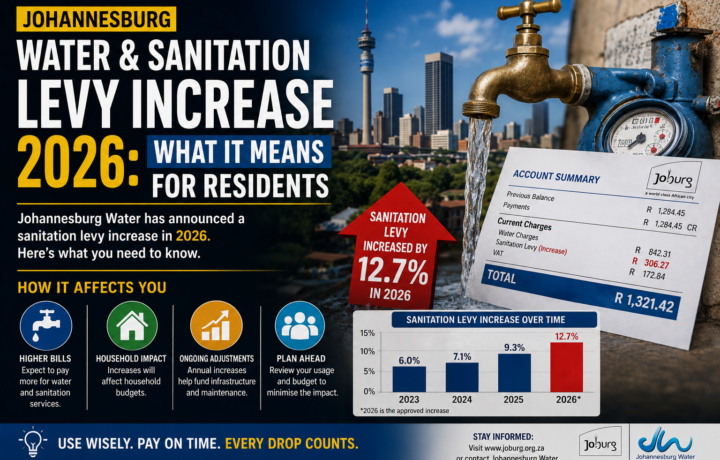
This outage did not happen in a vacuum. Johannesburg’s water network has faced years of complaints over ageing infrastructure, high non-revenue water losses (water that is treated but never billed, due to leaks and illegal connections), and reservoirs that have run critically low even without a single dramatic incident like the Eikenhof failure. It follows closely on the heels of a separate, unrelated increase in Johannesburg’s water and sanitation levy — see our report on the sharp rise in Joburg’s monthly water levy — meaning residents are simultaneously paying more for a service that has just suffered one of its most disruptive failures in recent memory.
What happens next
Rand Water and the City of Johannesburg face pressure to explain both the immediate cause of the Eikenhof failure and the longer-term resilience of a system that can be knocked over by a single point of failure. Government’s water crisis committee, convened separately to address the national picture, is expected to report on broader infrastructure investment plans in the coming months.
How reservoir-fed water systems actually work
Understanding why a single pump station failure could cause such a widespread outage requires understanding the basic architecture of a metro water system. Treated water from a plant like Zuikerbosch is pushed through large-diameter pipelines to a network of reservoirs positioned at different elevations across a city, from which gravity then distributes water down to individual suburbs and households. Booster stations like Eikenhof exist specifically to push water uphill to reservoirs that gravity alone can’t reach from the treatment plant. When a booster station goes offline, every reservoir downstream of it stops being replenished, even though the reservoirs themselves are undamaged — they simply begin draining as normal household and business usage continues without the corresponding refill.
This is why restoration doesn’t happen instantly even once power is restored to a failed station: reservoirs need time to refill to workable levels before consistent pressure and supply return to the suburbs and towns furthest from the treatment plant, and low-lying areas typically recover faster than high-lying ones for the same reason.
A pattern that stretches beyond this single incident
Johannesburg has experienced multiple significant water disruptions in recent years, often linked to a combination of ageing infrastructure, power failures at critical pumping installations, and high water losses across an extensive and old reticulation network. Each individual incident tends to be reported and addressed largely on its own terms — a specific fault, a specific repair timeline — but taken together, the recurring pattern points toward a system operating with less resilience and redundancy than a city of Johannesburg’s size and economic importance arguably requires.
What government’s national water crisis response involves
This incident lands against the backdrop of a broader national response: President Ramaphosa has established a National Water Crisis Committee, with a multi-year funding allocation earmarked to address ageing water infrastructure nationally, not only in Johannesburg. Whether that broader funding and coordination effort translates into fewer incidents like the Eikenhof failure going forward will depend heavily on how quickly it moves from committee-level planning into funded, executed infrastructure projects on the ground.
What “critical infrastructure” resilience would actually look like
Engineers who study infrastructure resilience generally recommend redundancy — backup capacity or alternative routing that allows a system to keep functioning, even in a degraded state, when a single critical node fails — as the core design principle for avoiding exactly this kind of cascading outage. Whether Rand Water’s network can realistically be retrofitted with that kind of redundancy at critical points like Eikenhof, and at what cost, is likely to be a central question in any post-incident technical review.
Frequently asked questions
What caused the Eikenhof booster station failure?
Reports describe an explosion or major electrical failure affecting the power lines feeding the station; a full technical cause had not been independently confirmed in publicly available reporting at the time of writing.
Is this linked to load shedding?
No — this was a localised electrical fault at a specific pumping installation, distinct from national load shedding, which Eskom has reported has not occurred for an extended period. See our report on Eskom’s 400 days without load shedding for that separate story.
Sources Used
- News24 — 'Power outage disrupts water supply to large parts of southern Johannesburg'
- Moneyweb — 'Explosion at water treatment plant throttles Joburg supply'
- Bloomberg — utility warning on Eikenhof blast impact
- Engineering News — Eikenhof booster station outage report
- SAnews.gov.za — meeting on Zuikerbosch water plant impact