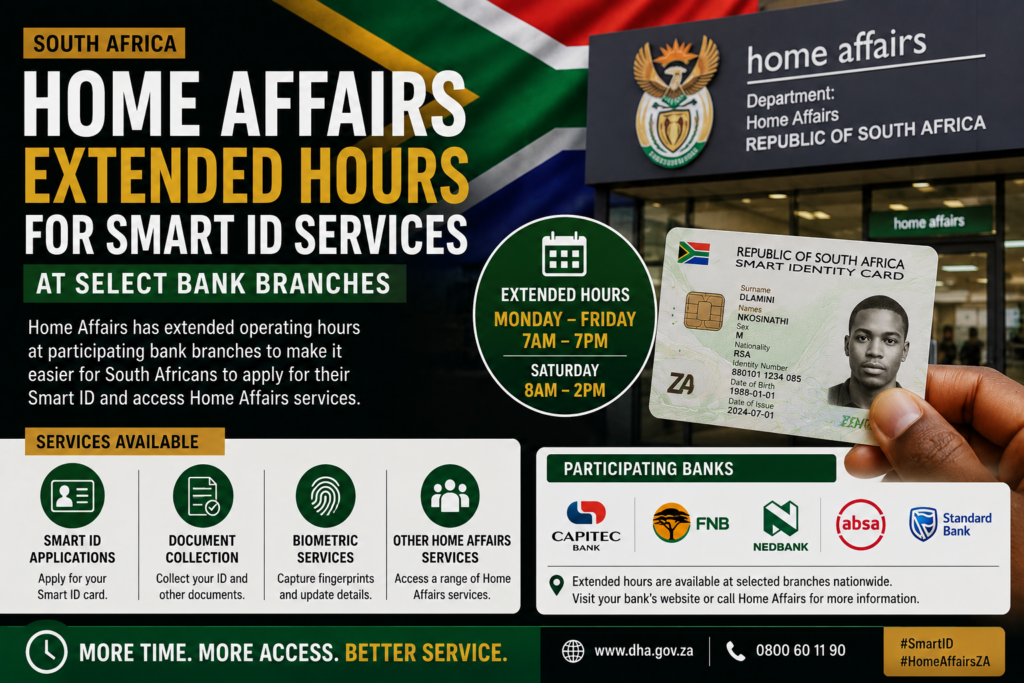
The Department of Home Affairs extended its office hours until 6pm from 1 to 21 July 2026 — two hours later than the usual 4pm closing time — to help learners and members of the public apply for or collect Smart ID cards during the school holidays. The move is part of a broader push by the department to modernise service delivery, which has also seen Smart ID replacement services rolled out to more than 200 bank branches around the country.
What’s changed
According to SAnews, the government’s official news service, Home Affairs offices kept extended hours specifically to accommodate the increased demand typical of the July school holiday period, when parents and learners have more availability to visit in person. The department has framed the extension as a practical response to seasonal demand rather than a permanent change to operating hours.
Separately, and on a longer timeline, Home Affairs has expanded a partnership allowing Smart ID card replacement services at 203 bank branches nationally. Reporting indicates the service, which launched on 9 March 2026, has already been used by more than a quarter of a million people — a sign of how much appetite there is for accessing basic Home Affairs services somewhere other than a traditional, often crowded, Home Affairs office.
Why this matters for practical, everyday reasons
Long queues at Home Affairs offices have been a persistent, well-documented frustration for South Africans needing an ID, passport or other civil documents. Extending hours during a predictably busy period, and offering an alternative channel through bank branches, are both aimed at the same underlying problem: too much demand concentrated into too few service points during standard working hours, which historically has meant taking unpaid leave or arriving before dawn to queue.
- The extended 6pm closing time applied specifically to the 1–21 July 2026 window, coinciding with school holidays — it is not confirmed as a permanent change.
- The 203 participating bank branches for Smart ID replacement services are separate from standard Home Affairs offices, and offer replacement services specifically, which may not cover every category of Home Affairs transaction.
- Both initiatives fall under the department’s “Home Affairs @ Home” reform programme, which combines technology modernisation with efforts to expand where and how citizens can access services.
What this means for readers needing Home Affairs services
Anyone needing to replace a lost or damaged Smart ID card should check whether a participating bank branch is more convenient than their nearest Home Affairs office, since the bank channel has been designed specifically to ease pressure on the department’s own front-line offices. For new applications, first-time ID applications, or passport services, a standard Home Affairs office visit generally remains necessary, since the bank partnership is targeted at replacements rather than the full range of services Home Affairs offers.
Background: a department under pressure to modernise
Home Affairs has faced years of criticism over queue times, system downtime and inconsistent service across its office network. The department has responded with a series of reforms bundled under its “Home Affairs @ Home” banner, aiming to combine digital modernisation with expanded physical access points, of which the bank branch partnership and this holiday-period hours extension are two visible, concrete examples.
What happens next
With the extended July hours limited to the school holiday period, standard office hours are expected to resume once the window ends on 21 July 2026. The bank branch partnership, by contrast, appears to be an ongoing service rather than a temporary measure, and its usage numbers — already in the hundreds of thousands within a few months of launch — suggest it may expand further if demand continues.
Why service delivery reform has become politically important
Long queues and inconsistent service at government offices have been a recurring source of public frustration for years, and they carry real economic cost too — time spent queuing at a Home Affairs office during work hours is time not spent earning an income, particularly for informally employed or hourly-paid workers who don’t have the flexibility of paid leave. Reforms that reduce queuing time or offer alternative service channels therefore have a tangible impact on ordinary people’s daily lives, well beyond the administrative convenience they represent on paper.
Government has also faced sustained pressure to demonstrate that public service delivery is improving in visible, measurable ways, particularly given broader public frustration over service delivery failures in other areas, including municipal water and electricity infrastructure. Initiatives like extended hours and the bank branch partnership offer a comparatively low-cost, high-visibility way to show responsiveness, even if they don’t address every structural challenge facing the department.
How the bank partnership model works elsewhere
Partnering with private-sector infrastructure — in this case, bank branches — to extend the reach of government services is not a uniquely South African idea; several countries have experimented with similar arrangements to reduce the burden on centralised government offices, particularly for routine transactions like document replacement that don’t require extensive in-person verification beyond what a bank’s own KYC (know-your-customer) processes already involve. If usage of the Home Affairs bank branch partnership continues to grow at the pace suggested by the reported quarter-million users in its first few months, it could become a model for extending other routine Home Affairs services beyond Smart ID replacement in future.
What readers can do to make the most of the extended access
- Confirm your specific local Home Affairs office is participating in the extended 6pm hours before planning a visit, since implementation can vary by office.
- Bring all required documentation on a first visit to avoid a repeat trip — requirements for Smart ID applications and replacements are published on the Home Affairs website.
- Consider a participating bank branch specifically for a lost or damaged Smart ID card replacement, where queues have generally been shorter than at traditional Home Affairs offices during the service’s first months of operation.
Balancing modernisation with reach
Digital modernisation initiatives at government departments sometimes risk leaving behind citizens without reliable internet access, digital literacy, or a bank account through which to access partnered services like the Smart ID bank branch programme. Home Affairs’ approach — combining a digital partnership with more traditional measures like extended physical office hours — reflects an attempt to modernise without abandoning citizens who depend on in-person, walk-in access, which remains essential for a meaningful share of the population the department serves.
What this signals about future service delivery reform
Individually modest measures like extended hours and a bank partnership are unlikely, on their own, to resolve the deeper capacity and resourcing challenges Home Affairs has faced for years. But they do suggest a department willing to experiment with lower-cost, incremental improvements rather than waiting for a single, comprehensive fix. Whether that incremental approach compounds into meaningful, sustained improvement over time — or remains a series of isolated initiatives — will become clearer as further reforms under the “Home Affairs @ Home” programme are rolled out.
Frequently asked questions
Which bank branches offer Smart ID replacement services?
Home Affairs has not published a single definitive public list in the reporting reviewed for this article; readers should confirm participation and availability directly with their bank or the Department of Home Affairs before visiting.
Can I apply for a first-time Smart ID card at a bank branch?
The reported partnership focuses on Smart ID card replacement services; readers needing a first-time application should confirm current eligibility directly with Home Affairs or their bank, as service scope can change.
Sources Used
- SAnews.gov.za — 'Home Affairs extends operating hours'
- The South African — Home Affairs extended hours coverage
- Joburg ETC — Home Affairs Smart ID extended hours report