
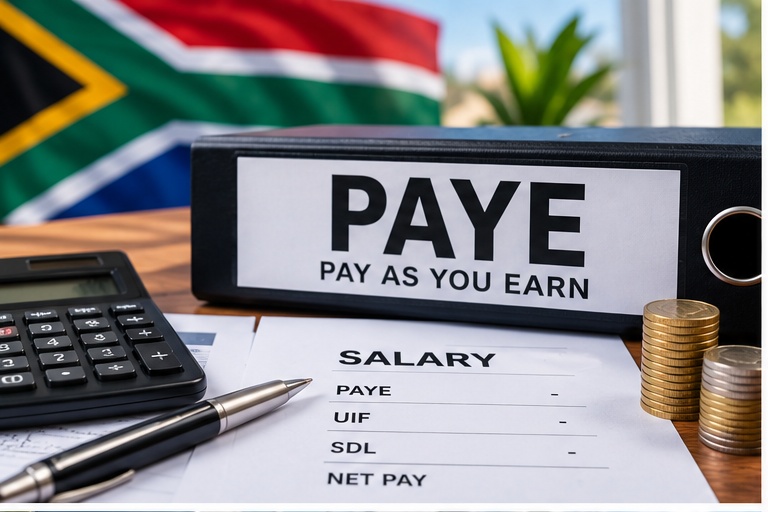
How Does PAYE Work in South Africa? Tax Deductions Explained
How does PAYE work in South Africa? PAYE, or Pay As You Earn, is the system employers use to deduct employees’ tax from remuneration and pay it to the South African Revenue Service (SARS). Instead of an employee waiting until the end of the tax year to pay their entire income-tax liability, qualifying tax is generally withheld from their pay during the year. The amount deducted depends on factors including taxable remuneration, the SARS tax tables, applicable rebates and certain tax credits. (South African Revenue Service)
In simple terms, if you are an employee, your employer calculates the PAYE that should be withheld from your remuneration, deducts it from your pay and declares the relevant amount to SARS. PAYE is therefore not a completely separate tax from income tax—it is a method used to collect employees’ income tax during the tax year.
This guide explains PAYE in straightforward language, including how it is calculated, why deductions can change, what appears on your payslip, what happens when you have two jobs, and what to do if you think your employer deducted the wrong amount.
Quick answer: PAYE is income tax collected from employees throughout the year through payroll. Your employer calculates the required deduction using SARS rules and pays the relevant amounts to SARS. At the end of the tax process, PAYE already withheld is taken into account when determining your final income-tax position.
Table of Contents
How Does PAYE Work in South Africa? Quick Explanation
| Question | Answer |
|---|---|
| What does PAYE mean? | Pay As You Earn |
| Who deducts PAYE? | Your employer or other qualifying payer |
| Where does the money go? | SARS |
| Is PAYE the same as income tax? | PAYE is a collection mechanism for employees’ tax |
| Is PAYE a fixed percentage? | No |
| Does everyone pay PAYE? | No |
| Can PAYE change from month to month? | Yes |
| Does your entire salary get taxed at your highest bracket? | No |
| Can two jobs create a tax shortfall? | Yes |
| Can additional PAYE be deducted? | Yes, including at an employee’s written request in appropriate circumstances |
| Where can you see annual PAYE information? | Your IRP5/IT3(a) tax certificate |
SARS requires employers to deduct or withhold PAYE according to prescribed tax tables or an applicable SARS tax directive. (South African Revenue Service)
What Is PAYE in South Africa?
PAYE stands for Pay As You Earn.
It is commonly shown as a deduction on an employee’s payslip.
Rather than requiring an employee to save enough money to settle a potentially large income-tax bill after the year has ended, PAYE allows employees’ tax to be collected through payroll during the year.
For example, suppose an employee receives taxable remuneration every month.
The employer’s payroll system considers the applicable SARS rules and calculates how much employees’ tax should be withheld.
The employer then:
- Calculates the applicable PAYE.
- Deducts it from the employee’s remuneration.
- Reports the relevant payroll taxes to SARS.
- Pays the relevant amounts to SARS.
- Eventually provides the employee with an IRP5/IT3(a) tax certificate containing annual tax information.
Employers use the monthly EMP201 declaration to report amounts including PAYE, UIF and SDL where applicable, and the amounts withheld must be paid to SARS monthly. (South African Revenue Service)
Is PAYE the Same as Income Tax?
This is one of the most important distinctions to understand.
PAYE is a way of collecting employees’ income tax during the year.
It should not be thought of as an unrelated tax that sits on top of your normal personal income tax.
Your final personal income-tax position can take account of much more than the PAYE appearing on one employer’s payroll.
Depending on your circumstances, SARS may ultimately consider:
- taxable employment income;
- other taxable income;
- tax already withheld;
- rebates;
- applicable tax credits;
- allowable deductions; and
- other relevant tax information.
This is why somebody can have PAYE deducted every month and still receive an assessment showing either an additional amount payable or a refund.
INTERNAL LINK
For readers who first need to understand personal income tax, link to:
How Does Income Tax Work in South Africa? 2026/27 Tax Brackets Explained
Recommended anchor:
how income tax works in South Africa
Use your actual Article 11 URL.
How Is PAYE Calculated in South Africa?
PAYE calculations can become technical, but the basic idea is understandable.
Employers use SARS’s tax deduction rules and tables to calculate employees’ tax.
For the 2027 year of assessment, running from 1 March 2026 to 28 February 2027, the personal income-tax brackets are: (South African Revenue Service)
| Taxable income | 2026/27 tax rate |
|---|---|
| R1 – R245,100 | 18% of taxable income |
| R245,101 – R383,100 | R44,118 + 26% above R245,100 |
| R383,101 – R530,200 | R79,998 + 31% above R383,100 |
| R530,201 – R695,800 | R125,599 + 36% above R530,200 |
| R695,801 – R887,000 | R185,215 + 39% above R695,800 |
| R887,001 – R1,878,600 | R259,783 + 41% above R887,000 |
| R1,878,601 and above | R666,339 + 45% above R1,878,600 |
These are progressive tax brackets.
That means earning enough to enter a higher bracket does not suddenly cause your entire taxable income to be taxed at that higher rate.
Does Your Entire Salary Get Taxed at Your Highest Tax Rate?
No.
This is a common misunderstanding.
Suppose part of your taxable income falls into a higher tax bracket.
The higher marginal rate applies to the portion falling into that bracket, not retrospectively to every rand you earned from the beginning.
For example, the 2026/27 table starts with an 18% bracket up to R245,100. The next bracket applies a base amount plus 26% to taxable income above R245,100. (South African Revenue Service)
That is why saying:
“I’m in the 31% bracket, so SARS takes 31% of my whole salary”
is generally incorrect.
The actual calculation uses the progressive tax table together with applicable rebates and other relevant tax rules.
What Are the PAYE Tax Thresholds for 2026/27?
SARS lists the following tax thresholds for the tax year from 1 March 2026 to 28 February 2027: (South African Revenue Service)
| Age | Annual tax threshold |
|---|---|
| Under 65 | R99,000 |
| 65 to under 75 | R153,250 |
| 75 and older | R171,300 |
The threshold is not the same thing as the first tax bracket.
That distinction matters.
The first bracket begins from the first rand of taxable income, but applicable tax rebates reduce the calculated tax liability.
For someone under 65, the primary rebate effectively produces the R99,000 threshold under the 2026/27 rates.
What Are the 2026/27 Tax Rebates?
For the 2026/27 tax year, SARS lists these rebates: (South African Revenue Service)
| Rebate | Amount |
|---|---|
| Primary rebate | R17,820 |
| Secondary rebate — age 65+ | R9,765 |
| Tertiary rebate — age 75+ | R3,249 |
The secondary and tertiary rebates are additional age-related rebates for qualifying taxpayers.
These rebates help explain why you cannot accurately calculate PAYE by simply multiplying a salary by the tax-bracket percentage.
PAYE Example: How the Calculation Works
Consider a simplified example of a person under 65 with annual taxable income of R300,000.
R300,000 falls within the second 2026/27 bracket.
The tax-table calculation is:
R44,118 + 26% of the amount above R245,100
Amount above R245,100:
R300,000 − R245,100 = R54,900
26% of R54,900:
R14,274
Add the base amount:
R44,118 + R14,274 = R58,392
Then apply the primary rebate of R17,820:
R58,392 − R17,820 = R40,572
That gives a simplified annual income-tax amount of R40,572, before considering other factors that could affect the employee’s actual calculation.
A simple monthly equivalent would be:
R40,572 ÷ 12 = R3,381
This example is for explanation only. Actual payroll calculations can differ because remuneration patterns, tax periods, medical tax credits, retirement contributions, directives, bonuses and other circumstances can affect PAYE.
Why Isn’t PAYE Simply 18% of My Salary?
Because the first tax bracket saying 18% does not mean every employee must hand over 18% of their gross salary.
For example, tax rebates reduce the calculated tax liability.
The primary rebate for 2026/27 is R17,820, which helps create the R99,000 tax threshold for someone under 65. (South African Revenue Service)
Furthermore, gross salary and taxable remuneration are not always identical for payroll-tax purposes.
This is why using:
Salary × 18%
is not a reliable way to check whether your PAYE is correct.
Is PAYE Calculated on Gross Salary or Basic Salary?
PAYE is calculated with reference to remuneration for employees’ tax purposes, not merely whichever figure on your payslip happens to be labelled “basic salary.”
Depending on the circumstances, remuneration can include more than basic cash salary.
Items such as certain:
- bonuses;
- allowances;
- fringe benefits;
- commissions; and
- other employment-related amounts
can have tax consequences.
Some payroll items may also receive particular treatment under tax legislation.
Therefore, two people with the same basic salary can potentially have different payroll-tax outcomes because their total remuneration packages are different.
Why Does My PAYE Change From Month to Month?
Your PAYE does not necessarily have to remain identical every month.
Several things can change your payroll calculation.
1. You received a salary increase
Higher taxable remuneration can increase the amount withheld.
2. You received a bonus
A bonus can change the employees’ tax calculation for the relevant period.
3. You earned commission or overtime
Variable remuneration can affect payroll tax.
4. Your benefits changed
A change to taxable benefits or applicable deductions can affect the calculation.
5. Your medical scheme information changed
Medical scheme tax credits can affect employees’ tax where applicable.
For 2026/27, the monthly medical scheme fees tax credit is R376 for the taxpayer, R376 for the first dependant and R254 for each additional dependant. (South African Revenue Service)
6. The tax tables changed
Employers need to update payroll systems when new SARS deduction tables take effect. The current 2026/27 tables took effect on 1 March 2026. (South African Revenue Service)
7. Payroll corrected an earlier calculation
SARS notes that employers may recalculate an employee’s final tax liability at the end of employment or the assessment period, potentially revealing an earlier over- or under-deduction. (South African Revenue Service)
A changing PAYE deduction is therefore not automatically evidence that payroll made a mistake.
How Does PAYE Work When You Get a Bonus?
Bonuses are generally not simply “tax-free extra money.”
A bonus forms part of remuneration and can affect the employee’s tax calculation.
The payroll system must determine the appropriate employees’ tax treatment under SARS rules.
This sometimes creates confusion because an employee may compare:
normal month’s PAYE
with:
bonus month’s PAYE
and conclude that the bonus itself was taxed at an enormous standalone rate.
Instead, look at the overall payroll calculation.
If you’re uncertain, ask payroll for an explanation of how the bonus and PAYE were calculated.
Why Does Overtime Affect PAYE?
The same broad principle applies to overtime.
If overtime increases your taxable remuneration for a period, it can change the amount of employees’ tax withheld.
That does not mean SARS has a special punishment tax for working overtime.
The change reflects the tax calculation on remuneration.
Employees should distinguish between:
“My PAYE increased because my taxable remuneration increased”
and
“Every rand of my overtime was taken by SARS.”
Those are not the same thing.
What Is the Difference Between PAYE and UIF?
PAYE and UIF are separate deductions.
PAYE
Employees’ tax collected for SARS toward income-tax obligations.
UIF
Contributions to the Unemployment Insurance Fund under the applicable unemployment-insurance system.
Your payslip can show both, but they serve different purposes.
Employers’ monthly EMP201 declarations can include PAYE and UIF, together with SDL and ETI information where applicable. (South African Revenue Service)
If you later become unemployed and need to understand UIF benefits, link to your existing News Domain guide:
INTERNAL LINK:
How to Claim UIF in South Africa
Recommended anchor:
how to claim UIF in South Africa
Use your actual Article 5 URL.
What Is the Difference Between PAYE and SDL?
SDL stands for Skills Development Levy.
It is another employment-related tax mechanism, but it is not the same as an employee’s PAYE.
Employees should therefore avoid assuming that every payroll-related acronym represents another portion of personal income tax.
PAYE, UIF and SDL have different legal purposes and rules.
Where Does the PAYE Deducted From Your Salary Go?
Your employer is responsible for withholding the applicable employees’ tax and declaring and paying amounts to SARS through the employer tax system.
SARS explains that employers submit the EMP201 Monthly Employer Declaration, which includes total PAYE and other applicable employment-tax amounts. (South African Revenue Service)
The EMP201 uses a SARS payment reference number to link the employer’s payment to the declaration.
As an employee, you generally do not manually transfer your normal monthly PAYE deduction to SARS yourself.
Your employer handles the withholding and employer declaration process.
How Do You Know How Much PAYE Your Employer Deducted?
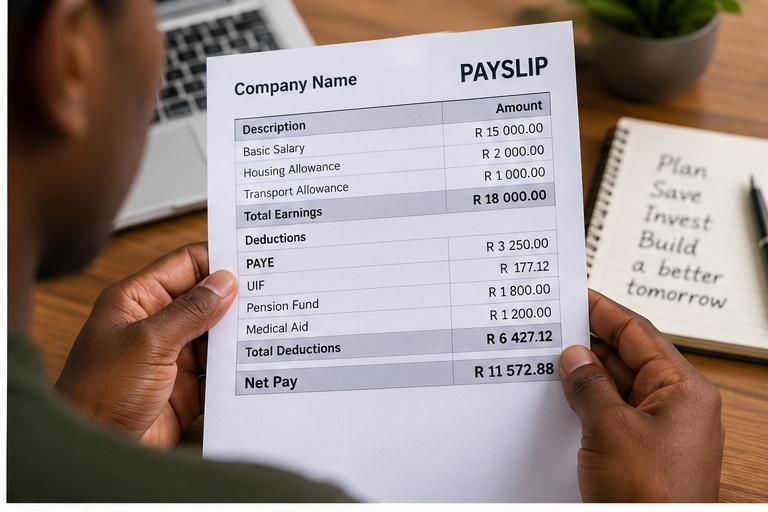
Start with your payslip.
It should show the deductions made from your remuneration.
You can also review your IRP5/IT3(a) tax certificate for annual employment-tax information.
Your IRP5 is particularly important when dealing with your income-tax return because it records employment income and employees’ tax information reported for the relevant period.
Keep your tax certificates and payslips.
They can be useful if you later need to investigate discrepancies.
What Is an IRP5?
An IRP5/IT3(a) is an employee tax certificate.
It contains information reported by an employer or other qualifying payer for tax purposes.
This can include:
- remuneration information;
- PAYE deducted;
- relevant income codes;
- deductions or contribution information; and
- other tax-certificate data.
Employers must reconcile payroll declarations and employee tax certificates as part of SARS’s employer reconciliation process. (South African Revenue Service)
When tax-return season arrives, check that your employment information is reflected correctly rather than assuming every pre-populated number must automatically be correct.
Can Your Employer Deduct Too Much PAYE?
Payroll errors are possible.
However, employers are not free to choose arbitrary PAYE amounts.
SARS states that employers must deduct employees’ tax according to the prescribed tax tables or an applicable directive and generally should not over- or under-deduct PAYE. An employee can, however, request in writing that an employer deduct an additional amount. (South African Revenue Service)
If you believe too much has been deducted:
- Check your payslip.
- Compare it with previous months.
- Check whether you received a bonus, overtime or another taxable payment.
- Check whether your benefits changed.
- Ask payroll for the calculation.
- Check your IRP5 when available.
- Compare the relevant SARS tax rules.
Do not assume an error solely because the deduction seems high.
What Happens If Too Much PAYE Was Deducted?
An over-deduction can affect your final tax position.
Depending on the circumstances, an employer’s recalculation or your SARS assessment may account for the PAYE already withheld.
A refund is not guaranteed merely because you believe your employer deducted too much.
SARS ultimately determines the tax position based on the information relevant to your assessment.
If your assessment shows that SARS owes you money and all applicable requirements are satisfied, a refund may result.
INTERNAL LINK
Readers who want to check their SARS account can read:
How to Check If You Owe SARS Money in South Africa
Recommended anchor:
how to check if you owe SARS money
Use your Article 12 URL.
What Happens If Too Little PAYE Was Deducted?
This can create the opposite problem.
If insufficient employees’ tax was withheld relative to your final tax liability, SARS may assess an additional amount payable.
That can surprise employees who believed:
“My employer deducted tax, so I can never owe SARS.”
PAYE reduces your tax liability by collecting tax during the year, but it does not guarantee that every taxpayer’s final position will always be exactly zero.
This becomes particularly important when you have multiple income sources.
How Does PAYE Work If You Have Two Jobs?
This is one of the most important situations to understand.
Suppose you have two employers.
Each employer may calculate PAYE based primarily on the remuneration it pays you.
But SARS ultimately looks at your relevant total taxable income when determining your personal income-tax liability.
Because South Africa uses progressive tax rates, combining income from two sources can result in a higher total liability than the combined PAYE deducted separately by each payer.
SARS specifically warns about this issue and provides a process for estimating the shortfall and asking one or more employers or pension funds to deduct additional PAYE. (South African Revenue Service)
Simple example
Imagine:
Employer A income: R200,000 per year
Employer B income: R150,000 per year
Together:
R350,000
The final tax calculation is based on the relevant combined taxable-income position, not two completely unrelated tax lives.
That can create a shortfall.
Can You Ask Your Employer to Deduct Extra PAYE?
Yes.
SARS says employees can arrange for additional PAYE deductions to help address an expected tax shortfall.
Its guidance for people with two sources of income recommends estimating total taxable income, calculating expected tax liability, comparing that with PAYE expected from the separate sources, and then arranging additional deductions to cover the shortfall. (South African Revenue Service)
This can be useful for someone who would rather pay more gradually during the year than receive a large assessment later.
What If You Change Jobs During the Tax Year?
Changing jobs does not create a new personal income-tax identity.
Your income from different employers during the same tax year can still form part of your overall annual tax position.
Keep:
- final payslips;
- IRP5 certificates;
- employment dates; and
- relevant SARS documents.
If your new employer asks for your tax number, use your existing Personal Income Tax number rather than trying to create a new one.
INTERNAL LINK
For readers who don’t have or cannot find a tax number:
How to Register for Tax With SARS in South Africa: Step-by-Step Guide
Recommended anchor:
how to register for tax with SARS
Use your Article 13 URL.
Does PAYE Automatically Mean You Must Submit a Tax Return?
Not necessarily.
Whether an individual is required to submit an income-tax return depends on the applicable SARS filing rules and the person’s circumstances.
PAYE being deducted does not by itself answer every filing question.
For example, other income, multiple employers and other tax circumstances can matter.
Check the current SARS filing requirements for the relevant tax year instead of relying on an old social-media post.
Do You Pay PAYE If You Earn Below the Tax Threshold?
For the 2026/27 tax year, an individual under 65 has an annual tax threshold of R99,000. (South African Revenue Service)
In a straightforward full-year situation where taxable income remains below the applicable threshold, normal income-tax liability may be zero after the rebate.
However, payroll situations can vary.
Don’t automatically assume a deduction is wrong without considering:
- how long you worked;
- the pay period;
- once-off payments;
- taxable benefits;
- bonuses;
- variable remuneration; and
- other relevant information.
If PAYE appears on your payslip unexpectedly, ask payroll to explain the calculation.
Does PAYE Apply to Freelancers?
PAYE is primarily associated with remuneration in an employer-employee or other employees’-tax relationship.
A genuinely self-employed freelancer’s tax affairs can work differently.
Someone earning freelance or business income may need to manage their own income-tax and potentially provisional-tax obligations depending on the circumstances.
The label “freelancer” alone does not determine tax treatment.
The nature of the working arrangement matters.
If you earn income outside normal employment, don’t assume that no PAYE deduction means no tax is payable.
Does PAYE Apply to Commission Earners?
Commission can form part of taxable remuneration, so PAYE can apply.
However, commission-based remuneration can make payroll deductions more variable because income may change significantly from month to month.
Tax directives and particular rules can also become relevant in certain circumstances.
If most of your remuneration comes from commission, check your tax certificate carefully and seek qualified assistance where your situation is complicated.
What Is a SARS Tax Directive?
A tax directive is an instruction issued by SARS telling an employer, fund administrator or other relevant payer how employees’ tax should be calculated or withheld in specified circumstances.
SARS notes that employers must deduct PAYE according to either prescribed tax tables or the amount/rate specified in a SARS tax directive where one applies. (South African Revenue Service)
A directive is therefore not something an employer simply invents.
It comes from SARS.
Can Your Employer Keep PAYE Instead of Paying SARS?
An employer has legal obligations relating to employees’ tax.
Amounts withheld and declared through the employer-tax system must be dealt with according to SARS requirements.
The monthly EMP201 process requires employers to declare the relevant PAYE and other employment-tax amounts and make payment to SARS. (South African Revenue Service)
If you have serious reason to believe PAYE is being deducted from your salary but your tax records are incorrect, don’t ignore the issue.
Keep your:
- employment contract;
- payslips;
- bank statements showing salary payments;
- IRP5 certificates; and
- communications with payroll.
Then use official SARS channels where necessary.
How Do You Check Whether Your PAYE Is Correct?
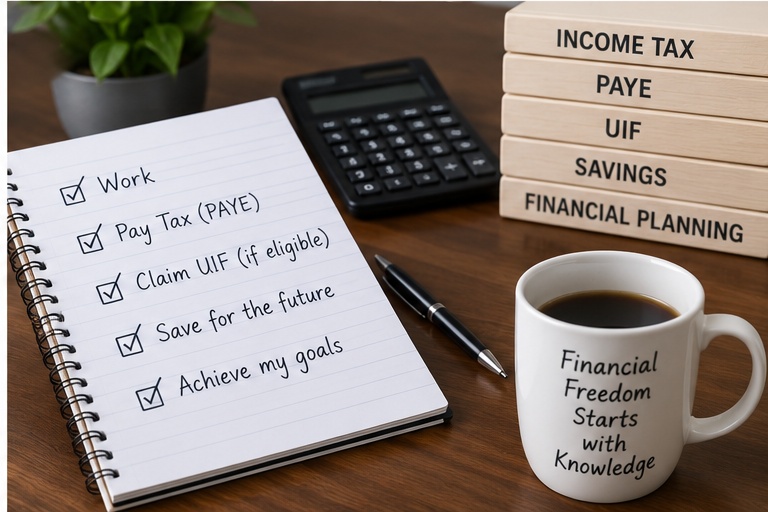
You don’t need to become a tax accountant to perform a basic reasonableness check.
Step 1: Check your taxable remuneration
Look at the income and benefits on your payslip.
Step 2: Check the correct tax year
For income earned between 1 March 2026 and 28 February 2027, use the 2026/27 rates. (South African Revenue Service)
Step 3: Check your age-related rebate
The primary rebate applies to qualifying individuals generally, with additional rebates for those aged 65+ and 75+. (South African Revenue Service)
Step 4: Consider medical tax credits
If applicable, medical scheme tax credits can affect PAYE.
Step 5: Consider variable remuneration
Did you receive:
- overtime;
- commission;
- bonus;
- allowances; or
- taxable benefits?
Step 6: Ask payroll
If the calculation still doesn’t make sense, ask your employer’s payroll department to explain it.
Step 7: Compare your IRP5
When available, compare the annual tax certificate with your employment records.
Common PAYE Mistakes Employees Make
Understanding these misconceptions can prevent unnecessary panic.
Mistake 1: “My tax bracket is my PAYE percentage”
Not necessarily. Progressive rates, rebates and other factors apply.
Mistake 2: “PAYE and UIF are the same thing”
They are not.
Mistake 3: “My whole salary is taxed at my highest bracket”
No. South Africa uses progressive personal income-tax brackets.
Mistake 4: “If PAYE was deducted, I can never owe SARS”
Incorrect. Your final assessment can differ.
Mistake 5: “If I have two employers, each job is taxed completely separately”
Your final personal tax liability can reflect your combined taxable-income position.
Mistake 6: “A bonus has its own completely separate tax”
A bonus forms part of the remuneration/tax calculation rather than existing in a separate tax universe.
Mistake 7: “If PAYE changes, payroll must have made a mistake”
Variable remuneration and other changes can legitimately alter the deduction.
PAYE vs Income Tax vs UIF: Simple Comparison
| Item | What it is | Who handles it? |
|---|---|---|
| Income tax | Tax on taxable income | SARS/taxpayer |
| PAYE | Employees’ tax withheld during the year | Employer/SARS |
| UIF | Unemployment insurance contribution | Employer/employee/UIF system |
| SDL | Skills Development Levy | Qualifying employer |
| IRP5 | Employee tax certificate | Employer issues/reports it |
This is why reading a payslip becomes much easier once you stop treating every deduction as “tax.”
Frequently Asked Questions About How PAYE Works in South Africa
How does PAYE work in South Africa?
PAYE allows employers to deduct employees’ tax from remuneration during the year and pay the relevant amounts to SARS. Employers must use SARS’s prescribed deduction tables or an applicable tax directive. (South African Revenue Service)
What does PAYE stand for?
PAYE means Pay As You Earn.
Is PAYE the same as income tax?
PAYE is a mechanism for collecting employees’ tax toward an individual’s income-tax liability during the year. It is not simply an unrelated tax added on top of personal income tax.
How much must you earn before paying PAYE in South Africa?
For the 2026/27 tax year, the annual tax threshold is R99,000 for individuals under 65, R153,250 for those aged 65 to under 75, and R171,300 for people aged 75 or older. (South African Revenue Service)
Is PAYE calculated on basic or gross salary?
PAYE is based on remuneration as defined for employees’ tax purposes, which can include more than basic salary. Taxable benefits, bonuses, commission and other remuneration can affect the calculation.
Why is my PAYE different every month?
Salary changes, overtime, bonuses, commission, benefits, medical tax credits, payroll corrections and other remuneration changes can affect PAYE.
Why is PAYE higher when I get a bonus?
A bonus increases remuneration and can therefore change the employees’ tax calculation for the period. It does not mean SARS necessarily applies a completely separate “bonus tax.”
Can I get PAYE back from SARS?
If your final assessment determines that too much tax was paid and you are entitled to a refund, SARS may refund the applicable amount. A PAYE deduction by itself does not guarantee a refund.
What happens if my employer deducts too little PAYE?
If your final income-tax liability exceeds the tax already paid or withheld, you could have an amount owing to SARS.
Can I ask my employer to deduct more PAYE?
Yes. SARS allows an employee to request additional PAYE deductions, which can be particularly useful when multiple income sources may create a shortfall. (South African Revenue Service)
What happens if I have two jobs?
PAYE may be deducted by each employer, but your final income-tax position can take account of your combined taxable income. This can result in an additional amount owing if insufficient PAYE was withheld overall. (South African Revenue Service)
Is PAYE the same as UIF?
No. PAYE relates to employees’ tax, while UIF relates to unemployment insurance.
Where can I see my PAYE deduction?
Your payslip should show payroll deductions, and your IRP5/IT3(a) provides annual employee tax information.
Who pays PAYE to SARS?
The employer withholds applicable employees’ tax and pays the relevant amounts to SARS through the employer-tax process. (South African Revenue Service)
Does everyone who works pay PAYE?
No. Tax thresholds and the person’s remuneration and circumstances affect whether employees’ tax is payable.
What Should You Remember About PAYE?
If you searched how does PAYE work in South Africa, remember this:
PAYE is the system used to collect employees’ income tax through payroll during the tax year.
Your employer does not simply choose a random percentage.
Employers must use SARS’s prescribed tax deduction rules, tables or an applicable tax directive. (South African Revenue Service)
The amount can be affected by:
- taxable remuneration;
- annual tax brackets;
- tax rebates;
- medical tax credits;
- bonuses;
- overtime;
- commission;
- taxable benefits;
- multiple income sources; and
- other relevant circumstances.
For the 2026/27 tax year, the lowest individual tax bracket is 18%, but that does not mean every worker automatically loses 18% of their entire salary to PAYE. Tax rebates and the progressive tax system matter. (South African Revenue Service)
If your PAYE suddenly changes, check your payslip before assuming something is wrong.
If you have two employers or other income, pay particular attention to your total tax position because separate PAYE deductions can still leave a shortfall.
And if you think the deduction is incorrect, ask payroll for the calculation and compare it with current SARS information.
For more information, use SARS’s current employer tax guidance: