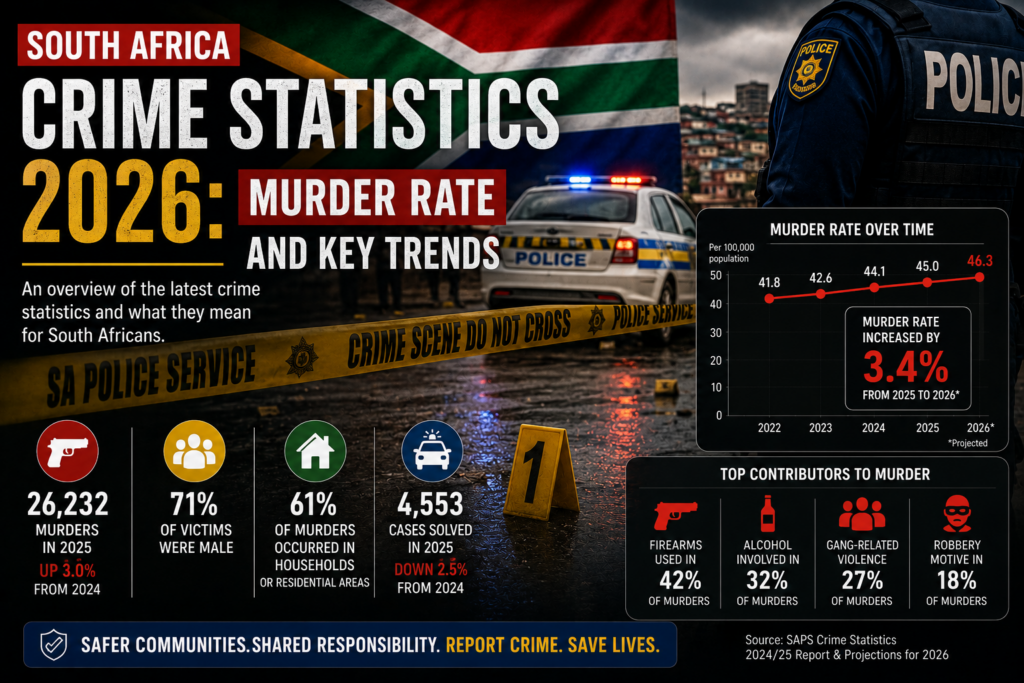
South Africa recorded 5,181 murders in the first quarter of 2026, down 9.5% from 5,727 in the same period the previous year, according to statistics released by Police Minister Firoz Cachalia in May 2026. The figures translate to an average of roughly 58 murders a day across the country — a decline worth noting, but one that still leaves South Africa with one of the highest murder rates in the world.
What the latest statistics show
Alongside the drop in murders, overall violent contact crime fell 4.6% year-on-year. House robberies were down 20.4% and business robberies down 18.3%, according to the release. But the data also surfaced findings that complicate any simple “crime is falling” narrative: 1,523 of the quarter’s murders occurred inside a home, and nearly half of reported rapes — 4,620 out of 9,782 cases — also happened in a domestic setting. Police also linked more than 7,200 incidents of murder, attempted murder, rape and assault to alcohol.
What’s changing in how crime is being addressed
Alongside the statistics release, former SARS Commissioner Edward Kieswetter was appointed to chair a new Police Advisory Panel, tied to broader reforms flowing from the Madlanga Commission — a body examining allegations of dysfunction and misconduct within elements of the criminal justice system. The appointment of a figure known for turning around a major state institution’s operational credibility signals that government sees institutional and governance reform, not just enforcement numbers, as part of the response to crime.
Why the numbers matter beyond the headline decline
A falling murder rate is genuinely significant, but it needs context. South Africa’s murder rate remains dramatically higher than international norms even after this decline, and the finding that a large share of murders and rapes occur in homes points to domestic and interpersonal violence as a persistent, harder-to-police problem than crime carried out by strangers in public spaces. The alcohol linkage across more than 7,200 violent incidents also points toward a policy lever — alcohol regulation and enforcement — that sits outside conventional policing responses.
- Murders: down 9.5% year-on-year, but still averaging around 58 a day nationally.
- House and business robberies: down 20.4% and 18.3% respectively.
- Home-based violence: nearly a third of murders and close to half of reported rapes occurred in a domestic setting.
- Alcohol-linked violent crime: more than 7,200 recorded incidents tied to alcohol use.
What this means for households
The data is a reminder that personal safety strategies aimed primarily at guarding against stranger danger — burglar bars, alarm systems, neighbourhood watches — address only part of the risk picture reflected in these statistics. Organisations working on gender-based violence and domestic abuse consistently point to the same pattern seen in this release: that home is not automatically the safest place, and that support services, protection orders and community reporting channels remain critical tools separate from conventional crime prevention.
Background: how South Africa’s crime statistics are compiled
The South African Police Service releases quarterly crime statistics compiled from reported cases across the country’s police stations. These figures capture reported crime, meaning they can be affected both by real changes in crime levels and by changes in how willing victims are to report incidents to police — a caveat that applies to any set of official crime statistics, in South Africa or elsewhere.
What happens next
The newly appointed Police Advisory Panel under Edward Kieswetter is expected to focus on institutional reforms flowing from the Madlanga Commission’s findings, while the next quarterly crime statistics release will show whether the murder rate decline recorded in Q1 2026 continues or reverses.
What “crime happens mostly at home” means for policy
The finding that a substantial share of murders and rapes occur inside homes has real implications for how effective a purely visible, patrol-based policing response can be. Additional police visibility on streets and in public spaces — a common public demand after any crime statistics release — is more likely to affect crimes committed by strangers in public areas than the domestic and interpersonal violence this data set shows makes up a large share of total cases. Effective responses to domestic violence typically require a different toolkit: accessible protection order processes, adequately resourced victim support services, specialised police training for responding to domestic incidents, and community-level interventions addressing alcohol abuse, given the statistics’ clear link between alcohol and violent crime.
How South Africa’s crime statistics compare internationally
Even after the reported 9.5% year-on-year decline, South Africa’s murder rate remains many times higher than the global average and higher than most middle-income countries with comparable economic profiles. This context matters for interpreting a single quarter’s improvement: a meaningful percentage decline from a very high base can still leave a country facing what would be considered, by international standards, an acute ongoing crisis. Sustained multi-year declines, rather than a single quarter’s figures, would be needed before South Africa’s murder rate approaches levels considered more typical internationally.
Where crime statistics come from, and their limits
It’s worth noting that South Africa’s official crime statistics measure reported crime specifically. Under-reporting is a well-documented issue for certain crime categories, particularly domestic and sexual violence, where survivors may not report to police for a range of reasons including fear, stigma, or lack of confidence in the justice system’s response. This means the true scale of some categories of violent crime, particularly the home-based violence highlighted in this release, could be higher than the reported figures suggest — a caveat criminologists routinely apply when interpreting statistics of this kind.
What a sustained decline would require
Turning a single quarter’s improvement into a durable, multi-year decline in violent crime typically requires sustained investment across several fronts simultaneously: adequately resourced and trained police stations, functioning forensic and detective capacity to secure convictions (addressing the low conviction rates that have drawn criticism separately), and social interventions addressing root drivers such as alcohol abuse and domestic violence. A single quarter’s positive statistics are a reasonable starting point for cautious optimism, but they are not, on their own, evidence that these deeper structural investments have yet been made at the scale required.
What the numbers don’t capture
Statistics measure incidents, not the lived experience of fear or vulnerability that shapes how South Africans actually navigate daily life — decisions about which routes to walk, what time to be home, whether to answer the door to a stranger. A falling murder rate is genuinely good news by any reasonable measure, but it doesn’t necessarily translate immediately into a changed sense of safety for people whose daily behaviour has been shaped by years of exposure to crime risk, and that gap between statistical improvement and felt safety is itself worth acknowledging honestly.
Frequently asked questions
Is South Africa’s crime rate improving overall?
The Q1 2026 data shows declines in several major categories, including murder, but violent crime — particularly domestic and alcohol-linked violence — remains a serious, largely unresolved problem according to the same release.
Who is Edward Kieswetter, and what will the Police Advisory Panel do?
Kieswetter is the former Commissioner of the South African Revenue Service, appointed to chair a new panel advising on police reforms connected to the Madlanga Commission’s findings on institutional dysfunction.
Sources Used
- News24 — 'Murder rate in SA dropped by 9.5%, says police minister'
- gov.za — Acting Minister Firoz Cachalia, Q1 2026 crime statistics briefing
- IOL — 'South Africa sees a decline in murders but organised crime remains a pressing issue'