
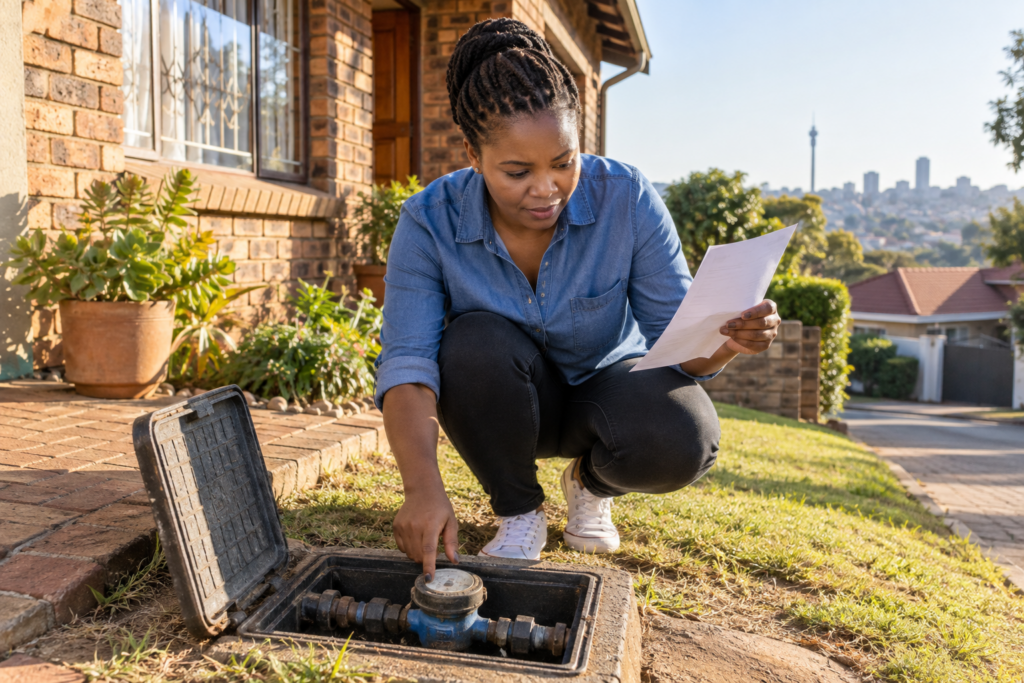
How to Dispute an Estimated Water Bill in Johannesburg: 7 Practical Steps
To dispute an estimated water bill in Johannesburg, compare the billed readings with your meter, gather dated photographs and previous statements, and lodge a documented billing query with the City of Johannesburg. Obtain a reference number, request a review of the specific charges, and ask in writing how the disputed amount will be handled while the investigation continues.
A large bill is worrying, particularly when your household’s water use has not noticeably changed. However, the amount alone does not tell you whether the problem is an inflated estimate, a catch-up adjustment, an incorrect meter number or water escaping through a leak.
This guide helps you identify what to question, organise evidence and follow up effectively. It covers conventional metered municipal accounts. Prepaid meters and privately billed complex accounts can require different checks.
Contact information and official web guidance checked on 20 September 2026. This is general consumer information, not advice on the legal position of a particular account.
Table of Contents
What Does an Estimated Water Bill Actually Mean?
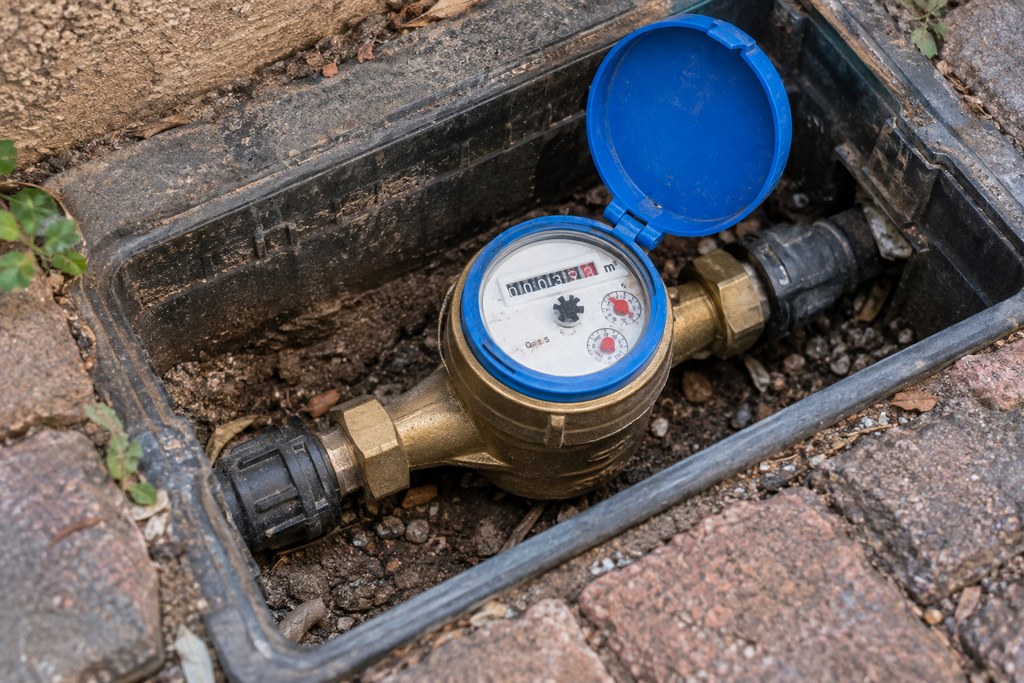
An estimated reading is a calculated figure used instead of a verified reading for the relevant billing date. It is different from a photograph or observation of the meter’s actual register.
Start by identifying whether the statement explicitly describes the reading as estimated. Do not assume that an unfamiliar abbreviation means “estimated”; ask the City to explain its reading codes if the statement has no key.
An estimate can be higher or lower than the amount eventually established through actual readings. When a later actual reading becomes available, the billing history may need to be reconciled. This is why checking one statement in isolation can be misleading.
Think of the reading as a running total, similar to a vehicle’s odometer. Your consumption is normally the difference between readings, not the total number currently displayed on the meter.
For example, a movement from 1,240 kilolitres to 1,258 kilolitres represents 18 kilolitres. It does not mean the household used 1,258 kilolitres that month. One kilolitre is 1,000 litres.
An estimate is not automatically proof of overcharging
Your complaint needs to identify a discrepancy. “The bill is estimated” describes the reading method. “The estimated closing reading exceeds the later photographed reading on the same meter” identifies something that needs investigation.
Equally, a bill marked actual can still warrant a query if its meter number, reading, dates or calculation appear wrong. Focus on the evidence rather than relying only on the reading label.
Before Disputing the Bill, Identify Which Problem You Have
Use this table to decide what to investigate first. These are diagnostic suggestions, not findings about your account.
| What you notice | What to investigate | Evidence to collect |
|---|---|---|
| The billed reading is higher than a later reading on the same meter | Possible excessive estimate or recording error | Dated photographs, serial number and statement |
| A large charge follows several estimated bills | Possible reconciliation of previously unbilled consumption | Statements spanning the last two verified actual readings |
| The meter number differs from the statement | Meter replacement or incorrect account association | Meter photograph and any replacement records |
| The register advances while all known water use is stopped | Possible leak or unrecognised demand | Before-and-after photographs and plumber’s findings |
| Water consumption looks reasonable but the account total is high | Other charges, arrears, payment allocation or tariff questions | Complete statement and payment records |
| A managing agent sends the bill | Private submeter or allocation issue | Agent’s calculation and underlying meter records |
How to Dispute an Estimated Water Bill in Johannesburg
Step 1: Check the water section, not only the total amount due
Download the full statement or use the complete paper bill. A payment reminder showing only the balance is not enough to investigate consumption.
Write down the following details:
- Account number and property address.
- Statement date.
- Water meter number.
- Opening and closing reading dates.
- Opening and closing readings.
- Consumption in kilolitres.
- Water charge for the relevant period.
Record the water charge separately from the overall municipal balance.
Next, check whether the amount due includes an old balance, interest, adjustments or other municipal services. A recent payment that has not appeared on the account is a different issue from an incorrect water reading.
For example, if the statement total is R4,800 but the water charge is R950, describing the entire R4,800 as an excessive water charge obscures the problem. Ask about the water entry and investigate the other components separately.
These figures are illustrative, not Johannesburg tariffs.
Also compare the number of days between readings. A longer consumption period can produce a larger volume without a higher daily usage rate. Divide kilolitres by the number of days to make a fairer comparison between periods.
For instance, 20 kL over 40 days and 15 kL over 30 days both represent an average of 0.5 kL per day. The first bill covers more water, but the daily consumption rate is identical.
If you cannot identify the last actual reading, request the reading history. Ask the City to distinguish actual readings, estimates, reversals and adjustments rather than sending only a balance summary.
Step 2: Photograph the correct water meter
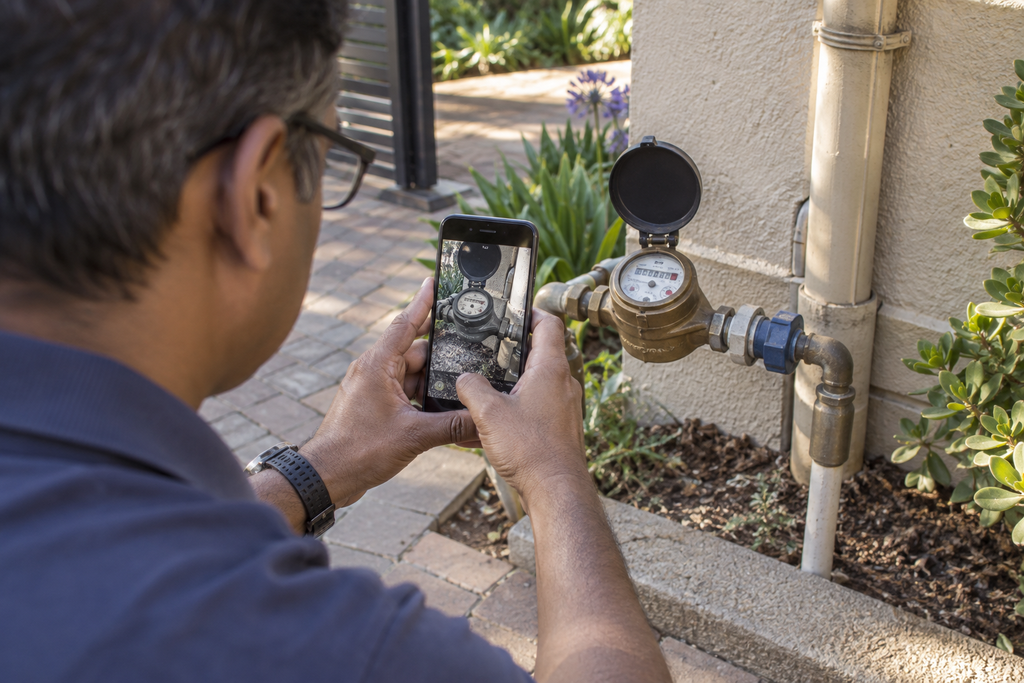
Check the meter’s serial number before relying on its reading. This is especially important in complexes, subdivided properties and buildings with several meters next to each other.
Take three useful photographs:
- A clear close-up of the meter register.
- A photograph showing the meter’s serial number.
- A wider photograph showing where the meter is located.
Record the date and time separately and keep the original image files.
Read the measurement markings carefully. Some displays separate whole kilolitres from smaller fractions using colours or decimal positions, but designs vary. Photograph the complete display rather than guessing which digits belong in the submission.
Do not open sealed equipment, remove the meter or enter an unsafe chamber. If the register is unreadable, submerged or inaccessible, photograph the situation from a safe position and request assistance.
If the serial number differs from your statement, ask whether a replacement was recorded. A new meter can start at a much lower reading than an old one, so a lower current number does not by itself prove overbilling.
Where replacement is relevant, request:
- The old meter’s final reading.
- The new meter’s starting reading.
- Both meter serial numbers.
- The changeover date.
Comparing readings across different meters without these details can produce a false conclusion.
Step 3: Build a short reading history
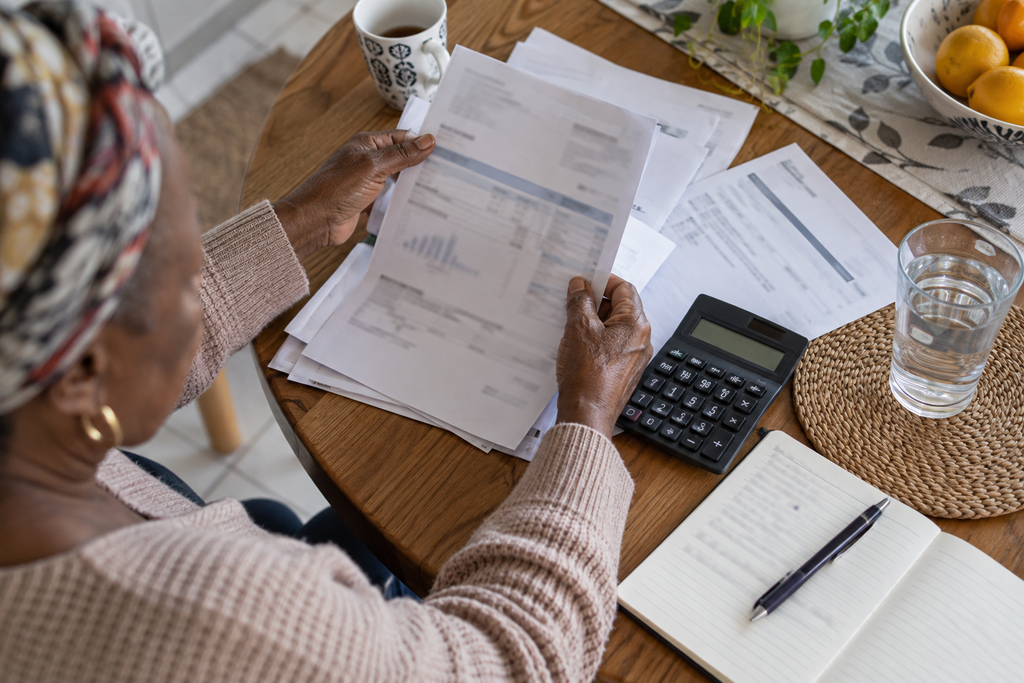
Gather enough statements to include the most recent reliable actual reading before the disputed period. If estimates have continued for several months, two bills may not show the full picture.
Create a simple record with four columns: reading date, reading, reading type and source. Label your own photographs as customer observations rather than presenting them as official readings.
Here is a fictional example:
| Date | Reading | Type | Source |
|---|---|---|---|
| 1 June | 1,000 kL | Actual | Municipal statement |
| 1 July | 1,018 kL | Estimated | Municipal statement |
| 1 August | 1,036 kL | Estimated | Municipal statement |
| 1 September | 1,090 kL | Estimated | Municipal statement |
| 5 September | 1,055 kL | Customer observation | Dated photograph |
If this is the same correctly identified meter, with no replacement or register rollover, the 1 September estimate appears inconsistent with the lower reading photographed four days later.
The difference between those two figures is 35 kL. However, that is not automatically the exact consumption or rand adjustment due. The photograph was taken on a different date, and the earlier estimates still need reconciliation.
A precise complaint would say:
Please investigate the estimated reading of 1,090 kL dated 1 September. My photograph of the same meter on 5 September shows 1,055 kL. Please verify the readings and reconcile the affected billing periods.
That gives an investigator a specific comparison to check without pretending you already know the final corrected bill.
Step 4: Check for a catch-up adjustment or possible leak
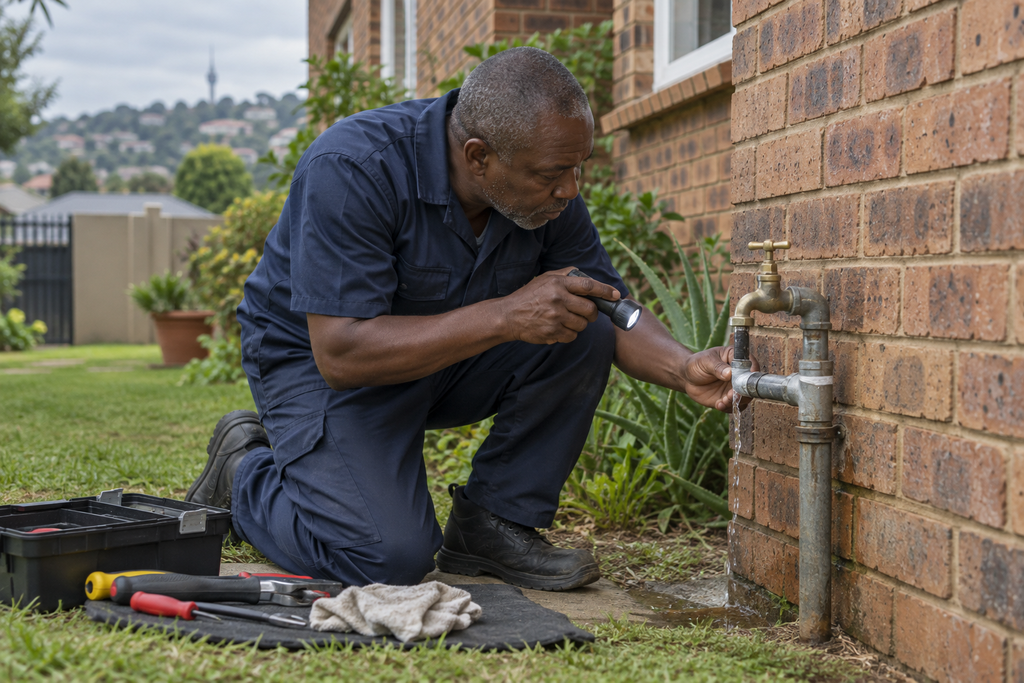
Before concluding that an increase is wrong, look at consumption between reliable actual readings.
Suppose a meter advanced from 2,000 kL to 2,075 kL over three months. Total measured use across that interval is 75 kL. If the earlier bills accounted for only 45 kL, another 30 kL remains to be reconciled at the consumption level.
This does not establish that the rand charge is correct. It simply explains why an actual reading can trigger a larger bill after low estimates.
Ask for the calculation showing how previous charges, reversals, dates and applicable tariffs were handled.
Check whether water is still being used unexpectedly
If the current reading suggests continuing high usage, carry out a basic observation check.
Turn off taps and make sure toilets, washing machines, irrigation and other water-using equipment are not drawing water. Note the meter reading, wait through a period of no intentional use, then check again.
Movement can indicate a leak or another source of demand. It does not identify the cause on its own. Automatic tank refilling, shared connections or a toilet cistern that keeps filling can complicate the observation.
A stationary register during a short check also does not rule out an intermittent leak. If uncertainty remains, ask a suitably qualified plumber to investigate the property’s plumbing.
Keep the plumber’s findings, repair invoice, dates and photographs. These help distinguish a billing error from water that actually passed through the meter.
Do not assume repairing a leak automatically qualifies you for a credit. Ask about any applicable policy and its evidence requirements.
Step 5: Lodge the account query and obtain a reference number
For municipal account enquiries, the official e-Joburg portal lists:
- Telephone: 0860 562 874.
- Email: Joburgconnect@joburg.org.za.
Use these to initiate the query and confirm the correct route for a formal billing dispute and supporting documents. The portal separately lists website support, which is intended for problems using the website. See e-Joburg’s official contact details.
Describe the issue as an estimated water-reading or billing dispute and identify the exact period. Attach the relevant statement, meter photographs and your short reading history.
Ask the official handling your enquiry to confirm:
- The reference number and date logged.
- Whether your submission is recorded as a billing query or a formal dispute.
- Any additional form or documentation required.
- The department responsible for investigating it.
- Whether a site reading or meter verification is needed.
- The expected next update and how you should follow up.
If you phone first, follow with a written summary through the confirmed official channel. Save the acknowledgement and attachments together.
A reference number helps track the issue; it is not proof that the requested correction has been accepted.
For a physical water fault, Johannesburg Water’s current homepage lists 010 061 4470 and identifies fault@jwater.co.za for water-related incidents.
Report a leak or damaged meter separately where necessary, and cross-reference that incident in your billing complaint. See Johannesburg Water’s official contact information.
Step 6: Ask how payments and the disputed balance will be handled
Do not assume that sending an email automatically suspends charges, interest or credit-control action. Ask for written confirmation of the status of the specific disputed amount and any further steps required.
Request a clear breakdown of what the City treats as disputed and undisputed. Keep paying amounts you accept as correctly due, and retain proof, but do not treat a self-selected partial payment as a guarantee against enforcement.
Ask how your payment will be allocated. A payment intended to cover current services may not appear against the component you expected, so the account ledger matters as much as the payment receipt.
If you receive a demand or disconnection notice, respond urgently through the contact route stated on the verified notice. Include your existing reference, dispute summary and supporting documents, and request a written response addressing the notice itself.
Where a substantial sum, imminent disconnection or unresolved legal disagreement is involved, seek advice from a qualified South African legal adviser. General guidance cannot establish the protection available on a particular account.
Step 7: Follow up until the account shows the outcome
Put the promised update date in your calendar. If none is given, ask for one. There is no basis here to promise that every disputed account will be corrected within a fixed number of days.
Use the existing reference when following up. State what remains unresolved and attach only the evidence needed to make that point clear.
For example:
The query was marked resolved, but the September statement still shows the estimated closing reading of 1,090 kL. Please provide the investigation findings and identify where the correction appears.
If the response does not address the evidence, request escalation through the City’s current complaints process. Ask for the appropriate supervisor or escalation channel and keep the original query history together.
A ward councillor may help you follow up on an unresolved municipal matter, but that follow-up is not a substitute for lodging the billing query or obtaining a formal account correction.
Once the City says the problem is resolved, check the actual statement. Look for the corrected reading, adjustment description, affected period and resulting balance.
Ask for clarification if only a credit appears without an explanation of how it was calculated.
Copy-and-Use Water Bill Dispute Template
Adapt this template to your evidence. Remove anything that does not apply and send sensitive account information only through verified official channels.
Subject: Estimated water billing dispute — account [number] — [property address]
Dear City of Johannesburg Customer Services,
I am querying the estimated water reading and associated charges on my municipal account for [billing period].
Account holder: [name]
Account number: [number]
Property address: [address]
Meter serial number: [number]
Statement date: [date]
Existing reference, if any: [reference]
The statement records [reading] kL on [date], described as [reading type]. My photograph taken on [date and time] shows [reading] kL on meter [serial number].
The discrepancy I would like investigated is: [brief explanation based on the evidence].
I attach the relevant statement, dated meter photographs and a summary of the reading history. [Add replacement records, payment evidence or a plumber’s report only if relevant.]
Please verify the meter linked to my account, confirm the last reliable actual reading, investigate the disputed estimate and provide a reconciliation of the affected charges. Please explain any reversals, replacement charges and tariff periods used.
Please also confirm the reference number, whether further steps are required to register a formal dispute, the expected next update, and how the disputed amount and payments will be handled while the matter is investigated.
If a site visit is required, please contact me to arrange access.
Kind regards,
[Name]
[Telephone number]
[Email address]
What if You Suspect the Meter Itself Is Faulty?
An excessive estimate and an inaccurate meter are different problems. A meter test checks the equipment; it does not automatically resolve an incorrect estimated figure entered into the billing system.
Johannesburg Water’s published testing guidance says three consecutive readings are required before testing and that a test fee is payable upfront.
It states that the fee is refunded and account adjustments made if the meter is found faulty. If the meter is not faulty, the fee is forfeited.
Confirm the current fee and arrangements before applying. See Johannesburg Water’s meter-testing procedure.
First ask whether the discrepancy can be explained by the reading history, meter identification or replacement records. If testing is necessary, retain the application, payment receipt and removal details, and request the written result.
What Tenants and Complex Residents Should Do Differently
If your landlord or managing agent bills you for water, establish whether the charge comes directly from a municipal account, a private submeter or an allocation across several units.
Ask for the opening and closing readings used for your unit, their dates, the meter number and the calculation behind the charge.
If the amount is allocated, request the allocation method and relevant underlying account information.
A photograph of your unit’s submeter may help challenge the agent’s calculation, but it may not correspond to the main municipal meter. Keep those two records separate.
Where the municipal account belongs to the owner or body corporate, ask that account holder to lodge or authorise the City query.
Keep your own complaint to the landlord or agent in writing as well. Responsibility for payment and access to records can depend on the arrangement, so avoid assuming every complex follows the same system.
Mistakes That Can Delay the Investigation
Sending only the total balance
Identify the water entry, reading and billing dates. The investigator needs to know which charge you challenge.
A screenshot of the amount due may show that the balance is high, but it does not explain how the water consumption was calculated.
Using an unclear photograph
A cropped register without a serial number may not establish which meter was photographed. Keep both views.
Check that the digits are readable before leaving the meter. Glare, shadows or a blurred photograph can make otherwise useful evidence difficult to assess.
Comparing different meters
Check for replacements before alleging that a reading went backwards. A new meter’s opening reading cannot be compared directly with an old meter’s closing reading without the changeover records.
Assuming every high bill is an estimate
Look for actual readings, adjustment entries, longer billing periods and genuine changes in consumption.
An incorrect estimate is one possible explanation, but it should not prevent you from investigating a leak or understanding a legitimate reconciliation.
Calculating a refund using one convenient tariff
Ask for the applicable rates and period-by-period reconciliation. A kilolitre discrepancy does not necessarily convert into a refund at one flat price.
Your own calculation can help identify a question, but it should not be presented as a confirmed adjustment without checking the billing method.
Opening disconnected complaints repeatedly
Follow up under the existing reference where possible. If a new reference is issued, ask for the cases to be linked.
Keep a short record of contact dates, officials’ names where provided, reference numbers and the next action promised.
Posting full statements on social media
Redact account numbers, addresses, contact details, barcodes and other personal information before sharing publicly.
Send complete records only where legitimately needed through verified channels. A public post does not replace a properly recorded account query.
Frequently Asked Questions
Can I dispute the bill if I do not know the exact rand amount that is wrong?
Yes, you can raise a query about a specific reading or calculation and request a reconciliation.
Explain what you can demonstrate, identify the affected period and ask what additional information is required for the formal dispute process. Do not invent a refund figure simply to fill a gap in the complaint.
Is a meter photograph enough to get a bill corrected?
A clear, dated photograph is useful evidence, but it does not guarantee a correction.
The City may need to verify the meter, reading dates and account history. Its value is strongest when the serial number is visible and the photograph is accompanied by the statement you are questioning.
Can a vacant property still receive a water charge?
A vacancy does not by itself establish that a bill is wrong.
Investigate whether the charge relates to an estimate, earlier consumption, a leak, someone accessing the property or another account component.
Supply the vacancy dates as context, alongside readings and photographs, rather than treating vacancy as the only evidence.
Will the City automatically refund money I have already paid?
Do not assume that a correction will produce an immediate cash refund.
Ask whether an approved adjustment will appear as an account credit and what process applies if you want money returned. Check the revised ledger and keep the original payment evidence.
How can I reduce the chance of another disputed estimate?
Keep a dated meter photograph at regular intervals and compare new statements with your records.
Where readings are repeatedly estimated, ask about access problems and the current accepted customer-reading procedure.
Confirm the applicable schedule rather than relying on an old schedule found online. Johannesburg Water has a meter-reading schedule page, but check the year of any document before using it.
Conclusion
The strongest water-bill complaint gives the City a discrepancy it can verify: the correct meter, dated readings, the affected statement and a clear request for reconciliation.
Start with those records, obtain a reference number and follow the matter through to the corrected account or written explanation. Address payment questions and any credit-control notice separately instead of assuming the complaint has dealt with them automatically.