
How Does Income Tax Work in South Africa? 2026/27 Tax Brackets Explained
How does income tax work in South Africa? Individuals generally pay tax on their taxable income, using a progressive system in which higher portions of income are taxed at higher rates. For the 2027 tax year, running from 1 March 2026 to 28 February 2027, individual tax rates range from 18% to 45%. Importantly, moving into a higher tax bracket does not mean your entire income is suddenly taxed at that higher percentage. (South African Revenue Service)
For employees, income tax is usually collected during the year through PAYE (Pay As You Earn) deducted by an employer. Your final tax position, however, depends on your taxable income, applicable rebates, deductions, tax credits and other circumstances.
This guide explains South African income tax in plain English, including the 2026/27 tax brackets, PAYE, tax thresholds, rebates, bonuses, multiple jobs and tax returns.
Quick answer: South Africa uses progressive individual income-tax brackets. You don’t simply multiply your entire salary by your highest tax rate. SARS calculates tax according to the bracket formula and then applies applicable rebates and tax credits.
How Does Income Tax Work in South Africa? Quick Summary
| Question | 2026/27 answer |
|---|---|
| Tax year | 1 March 2026 – 28 February 2027 |
| Lowest individual tax rate | 18% |
| Highest marginal rate | 45% |
| Tax threshold under 65 | R99,000 |
| Threshold age 65–74 | R153,250 |
| Threshold age 75+ | R171,300 |
| Primary rebate | R17,820 |
| Additional rebate from age 65 | R9,765 |
| Additional rebate from age 75 | R3,249 |
| Who administers income tax? | SARS |
These are SARS’s published figures for the 2027 year of assessment. The brackets received a 3.4% inflation adjustment in the 2026 Budget—the first inflationary bracket relief since 2023/24. (South African Revenue Service)
What Is Income Tax in South Africa?
Personal income tax is tax paid on an individual’s taxable income.
Salary is probably the most familiar example, but taxable income can arise from several sources.
SARS identifies examples including:
- Salaries and wages
- Bonuses
- Overtime
- Taxable fringe benefits
- Certain allowances
- Business or trading profits
- Director’s fees
- Certain investment income
- Rental profits
- Royalties
- Annuities
- Pension income
- Certain capital gains
(South African Revenue Service)
This is why asking only:
“What is my salary?”
doesn’t always tell SARS everything needed to determine your final income-tax liability.
Someone who earns only a salary from one employer may have relatively straightforward tax affairs.
Someone earning a salary, rental income and freelance income may have a more complicated tax position.
What Are the South African Income Tax Brackets for 2026/27?
These are the official SARS individual tax brackets applying from 1 March 2026 to 28 February 2027:
| Annual taxable income | Tax calculation |
|---|---|
| R1 – R245,100 | 18% of taxable income |
| R245,101 – R383,100 | R44,118 + 26% of amount above R245,100 |
| R383,101 – R530,200 | R79,998 + 31% of amount above R383,100 |
| R530,201 – R695,800 | R125,599 + 36% of amount above R530,200 |
| R695,801 – R887,000 | R185,215 + 39% of amount above R695,800 |
| R887,001 – R1,878,600 | R259,783 + 41% of amount above R887,000 |
| R1,878,601+ | R666,339 + 45% of amount above R1,878,600 |
(South African Revenue Service)
The most important thing to understand is that these are progressive brackets.
The highest percentage associated with your income is your marginal rate. It is not necessarily the percentage you effectively pay across your entire income.
Does Your Whole Salary Get Taxed at Your Highest Tax Rate?
No.
This is one of the most common misunderstandings about South African income tax.
Suppose your annual taxable income is:
R300,000
That falls into the second bracket.
SARS’s formula is:
R44,118 + 26% of taxable income above R245,100
The portion above R245,100 is:
R300,000 − R245,100 = R54,900
26% of R54,900 is:
R14,274
Add that to R44,118:
R44,118 + R14,274 = R58,392
That is the tax calculated before the applicable individual rebate and other relevant tax credits.
For someone under 65 who qualifies for the full primary rebate:
R58,392 − R17,820 = R40,572
So the simplified annual income-tax amount would be approximately:
R40,572
before considering other individual circumstances.
The taxpayer does not simply pay:
26% × R300,000 = R78,000
That would misunderstand how the bracket formula works.
What Is a Marginal Tax Rate?
Your marginal tax rate is the rate applying to the next portion of taxable income within your current bracket.
For example, if your taxable income is R300,000, you’re in the 26% bracket.
That does not mean you paid an effective 26% rate on the entire R300,000.
This distinction is extremely important when people receive:
- Salary increases
- Bonuses
- Overtime
- Commission
Some workers worry that a salary increase could leave them worse off because it “pushes them into another tax bracket.”
That’s generally a misunderstanding of progressive taxation.
Only the relevant portion entering the higher bracket is subjected to the higher marginal rate.
What Is the Tax Threshold in South Africa for 2026/27?
A tax threshold is the level below which an individual generally doesn’t pay income tax after the applicable standard age-related rebate.
For the 2027 tax year:
| Age | Annual tax threshold |
|---|---|
| Under 65 | R99,000 |
| 65 to under 75 | R153,250 |
| 75 and older | R171,300 |
(South African Revenue Service)
For someone younger than 65, R99,000 per year works out to an average of:
R8,250 per month
But be careful with this comparison.
The official threshold applies to the tax year and taxable-income calculation—not simply whatever number appears next to “gross pay” on one particular payslip.
Does That Mean Everyone Earning Less Than R8,250 Per Month Pays No Income Tax?
Not necessarily in every imaginable situation.
For a straightforward employee under 65 whose taxable income for the entire year remains below R99,000, the threshold means no normal income-tax liability arises based on that taxable income.
However, someone’s tax situation can become more complicated if they have:
- Multiple income sources
- Irregular income
- Taxable benefits
- Business income
- Rental income
- Investment income
- Other taxable amounts
So don’t use the monthly equivalent of the threshold as a universal payroll rule.
What Are Tax Rebates?
Tax rebates reduce the amount of tax calculated.
For 2026/27, SARS provides:
| Rebate | Amount |
|---|---|
| Primary rebate | R17,820 |
| Secondary rebate — 65+ | R9,765 |
| Tertiary rebate — 75+ | R3,249 |
(South African Revenue Service)
All qualifying individual taxpayers receive the primary rebate.
People aged 65 and older can receive the secondary rebate in addition to the primary rebate.
People aged 75 and older can receive the tertiary rebate in addition to the first two.
That produces combined rebates of:
Under 65: R17,820
65–74: R27,585
75+: R30,834
SARS confirms these combined age-related rebate amounts in its guidance for taxpayers with multiple income sources. (South African Revenue Service)
What Is PAYE in South Africa?
PAYE stands for Pay As You Earn.
For employees, PAYE is the mechanism through which employers deduct employees’ tax from remuneration and pay it to SARS.
Instead of waiting until the end of the tax year and then asking an employee for a large tax payment, the system generally collects tax throughout the year.
From 1 March 2026, employers needed to use the updated 2026/27 deduction tables and instructions. (South African Revenue Service)
On your payslip, you may therefore see something similar to:
PAYE: R___
This is income tax being withheld through payroll.
Is PAYE an Extra Tax?
No.
PAYE is not a separate additional tax on top of income tax.
It is a method of collecting employees’ tax during the year.
This distinction matters because people sometimes look at their payslip and think:
Income tax + PAYE = two taxes.
That is not how it works.
PAYE is essentially tax collected in advance against your income-tax liability.
How Does SARS Calculate PAYE?
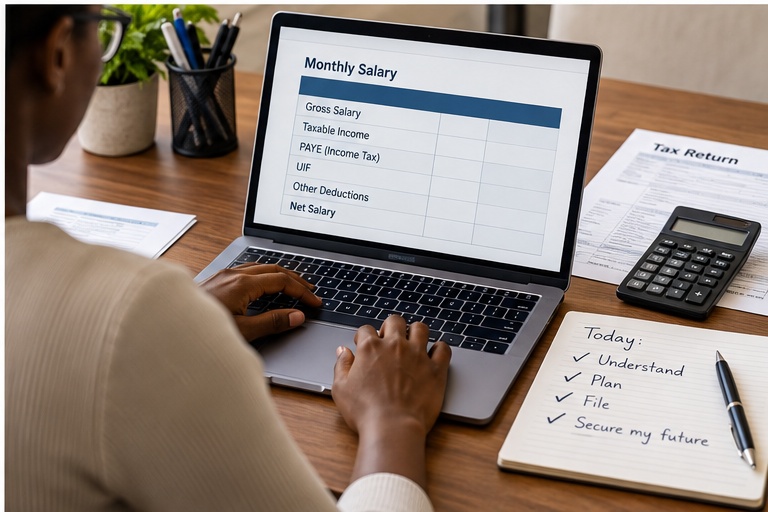
Employers use SARS’s employee-tax deduction rules and tables.
Broadly, payroll considers factors such as:
- Taxable remuneration
- Pay frequency
- Applicable tax bracket
- Tax rebates
- Certain tax credits and deductions processed through payroll
The exact payroll calculation can be more complicated than simply applying a percentage to your cash salary.
SARS publishes an official Guide for Employers in Respect of Employees’ Tax, including the current tax tables and deduction rules. (South African Revenue Service)
Gross Salary vs Taxable Income: What’s the Difference?
These terms should not automatically be treated as identical.
Gross salary
This generally refers to your earnings before deductions.
Depending on your employment, that might include:
- Basic salary
- Overtime
- Commission
- Bonuses
- Certain allowances
- Taxable benefits
Taxable income
Taxable income is the amount on which income tax is ultimately determined after applying the tax rules to income, exemptions and allowable deductions.
SARS describes income tax as tax paid on taxable income, not simply on whatever amount arrives in your bank account. (South African Revenue Service)
How Much Tax Do You Pay on R10,000 a Month?
Let’s use a simplified example.
Assume:
- Person is under 65.
- R10,000 monthly taxable income.
- R120,000 annual taxable income.
- No additional deductions or tax credits.
- Full primary rebate applies.
Because R120,000 falls within the first bracket:
18% × R120,000 = R21,600
Subtract primary rebate:
R21,600 − R17,820 = R3,780 annual income tax
Average monthly equivalent:
R3,780 ÷ 12 = R315
So the simplified example produces approximately:
R315 per month
This is an educational illustration, not a personalised SARS assessment or payroll calculation.
How Much Tax Do You Pay on R20,000 a Month?
Assume annual taxable income of:
R20,000 × 12 = R240,000
This remains within the first tax bracket.
Tax before rebate:
R240,000 × 18% = R43,200
Subtract the primary rebate:
R43,200 − R17,820 = R25,380
Average monthly equivalent:
R25,380 ÷ 12 = R2,115
So the simplified annual calculation is:
R25,380
with an average monthly equivalent of:
R2,115
Again, actual PAYE can differ depending on circumstances.
How Much Tax Do You Pay on R30,000 a Month?
Annual taxable income:
R30,000 × 12 = R360,000
This falls in the second bracket.
The SARS formula is:
R44,118 + 26% of taxable income above R245,100
Amount above R245,100:
R360,000 − R245,100 = R114,900
26%:
R29,874
Add:
R44,118 + R29,874 = R73,992
Subtract primary rebate:
R73,992 − R17,820 = R56,172
Average monthly equivalent:
R56,172 ÷ 12 = R4,681
So in this simplified example:
Annual income tax: R56,172
Average monthly equivalent: R4,681
How Much Tax Do You Pay on R50,000 a Month?
Annual taxable income:
R600,000
This falls into the fourth bracket:
R125,599 + 36% of taxable income above R530,200
Difference:
R600,000 − R530,200 = R69,800
36%:
R25,128
Add:
R125,599 + R25,128 = R150,727
Subtract primary rebate:
R150,727 − R17,820 = R132,907
Average monthly equivalent:
R132,907 ÷ 12 ≈ R11,075.58
Again, this is a simplified illustration assuming annual taxable income equals R600,000 and ignoring additional credits or deductions.
Simple 2026/27 Income Tax Examples
For an individual under 65, assuming the stated salary equals taxable income and only the primary rebate applies:
| Monthly taxable income | Annual taxable income | Approx. annual tax | Approx. monthly equivalent |
|---|---|---|---|
| R8,000 | R96,000 | R0 | R0 |
| R10,000 | R120,000 | R3,780 | R315 |
| R20,000 | R240,000 | R25,380 | R2,115 |
| R30,000 | R360,000 | R56,172 | R4,681 |
| R50,000 | R600,000 | R132,907 | R11,075.58 |
These calculations use SARS’s official 2026/27 individual tax brackets and primary rebate. (South African Revenue Service)
Important: This table is educational. It is not a substitute for an actual payroll calculation or tax assessment.
Why Is the Percentage on My Payslip Different From My Tax Bracket?
Because your marginal tax rate and effective tax rate are different concepts.
Suppose your highest marginal rate is 31%.
That does not mean 31% of every rand you earned is necessarily paid as income tax.
Your final tax calculation can involve:
- Progressive tax brackets
- Primary rebate
- Age-related rebates
- Medical tax credits
- Retirement contributions
- Other allowable deductions or adjustments
This is why dividing PAYE by gross salary can produce a percentage that doesn’t match the headline percentage for your bracket.
How Are Bonuses Taxed in South Africa?
A bonus is generally part of remuneration and can be taxable.
SARS explicitly lists bonuses among employment-related amounts from which taxable income can be determined. (South African Revenue Service)
However, saying:
“Bonuses are taxed at 40%”
or:
“SARS takes half your bonus”
is misleading as a general rule.
Your payroll system must account for the tax treatment of the additional remuneration based on applicable employees’ tax rules.
A bonus can make the PAYE deduction on that payslip look unusually high because additional remuneration affects the tax calculation.
But there is no universal special “bonus tax rate” that applies identically to every employee.
Can Overtime Push You Into a Higher Tax Bracket?
Additional taxable overtime increases your remuneration.
If enough additional taxable income moves part of your annual taxable income into the next bracket, that additional portion may be taxed at a higher marginal rate.
But your entire salary doesn’t suddenly get recalculated at the new highest rate.
For example, crossing from the 18% bracket into the 26% bracket doesn’t mean every rand you’ve earned for the year becomes taxed at 26%.
The bracket formula preserves the progressive calculation.
Will a Salary Increase Leave You With Less Money Because of Tax?
Ordinarily, moving into a higher tax bracket does not make your entire income subject to the higher marginal rate.
That means the common fear:
“Don’t accept the raise because you’ll enter another tax bracket and take home less than before”
misunderstands progressive income tax.
A higher salary can affect other income-linked benefits, deductions or circumstances, but the income-tax bracket itself does not work like a cliff where your entire salary is suddenly taxed at the new percentage.
What Happens If You Have Two Jobs?
This is an important area where taxpayers can get an unexpected tax bill.
Imagine you have:
Employer A and Employer B.
Each employer calculates PAYE based primarily on the remuneration it pays you.
But SARS ultimately considers your relevant combined taxable income when your overall tax position is determined.
SARS warns that receiving income from more than one source can result in too little PAYE being deducted during the year because each employer or pension fund may calculate deductions without accounting for the full combined income. (South African Revenue Service)
The result can be:
Tax owed when assessed.
SARS provides a process allowing taxpayers to estimate the shortfall and ask one or more employers or pension funds to deduct additional PAYE. (South African Revenue Service)
Do Freelancers Pay Income Tax in South Africa?
Potentially, yes.
Being paid as a freelancer does not automatically make income tax-free.
SARS includes profits from business or trade among amounts relevant to determining taxable income. (South African Revenue Service)
Depending on your circumstances, you may also become a provisional taxpayer.
SARS’s 2026 tax guide explains that a provisional taxpayer generally includes a person who earns income other than remuneration from an employer, subject to specified exclusions and thresholds. (South African Revenue Service)
Provisional tax is not a separate type of income tax.
It is a way of paying income tax during the year based on estimated taxable income.
What Is Provisional Tax?
Provisional tax allows qualifying taxpayers to pay income tax during the tax year rather than waiting for one large final payment.
It commonly matters to people earning income outside ordinary employment, including certain:
- Business owners
- Freelancers
- Independent contractors
- Landlords
- Investors
depending on their circumstances.
SARS says provisional taxpayers submit estimates of total taxable income and generally make advance payments during the year. (South African Revenue Service)
Not everyone with a small amount of non-salary income automatically becomes a provisional taxpayer, because exclusions apply.
Are Retirement Contributions Tax Deductible?
Qualifying contributions to pension, provident and retirement annuity funds can receive tax treatment under South African tax legislation, subject to applicable limits.
This can reduce taxable income.
However, don’t assume:
R1 contributed = R1 cash refund from SARS.
A deduction generally reduces the amount of income subject to tax. It is not necessarily a rand-for-rand refund.
The actual benefit depends on your tax position.
How Do Medical Aid Tax Credits Work?
Qualifying medical scheme contributions can generate a Medical Scheme Fees Tax Credit.
For the 2027 tax year, SARS lists the monthly credit as:
| Medical scheme membership | Monthly tax credit |
|---|---|
| Taxpayer | R376 |
| Taxpayer + one dependant | R752 total |
| Each additional dependant | R254 |
(South African Revenue Service)
These are tax credits, not deductions from taxable income.
A tax credit reduces the tax amount according to the applicable rules.
Additional medical-expense tax credits may also be available in qualifying circumstances, subject to separate rules.
Does Everyone Have to Submit a SARS Tax Return?
No.
Paying PAYE and being required to file an income-tax return are related but different questions.
Some taxpayers can be auto-assessed, while others need to submit a return.
Filing requirements depend on the taxpayer’s circumstances and the applicable SARS rules for the filing season.
For Filing Season 2026, SARS lists:
- Auto Assessments: 1–12 July 2026
- Non-provisional taxpayers: 13 July–23 October 2026
- Provisional taxpayers: 13 July 2026–22 January 2027
(South African Revenue Service)
An important distinction: Filing Season 2026 largely deals with the tax year that ended on 28 February 2026, while the 2026/27 tax rates discussed in this article apply to income earned from 1 March 2026 through 28 February 2027.
Don’t mix up the filing year and year of assessment.
What Is a SARS Auto Assessment?
An auto assessment is when SARS uses information it already receives from third parties to calculate a taxpayer’s assessment.
Information can come from sources such as:
- Employers
- Medical schemes
- Retirement funds
- Financial institutions
If SARS auto-assesses you, you should still check the information carefully.
Don’t simply assume every figure is correct because the assessment was generated automatically.
Verify relevant income, deductions, tax credits and third-party information against your records.
Can SARS Give You a Tax Refund?
Yes, in qualifying circumstances.
A refund can arise when the tax already paid exceeds the final assessed tax liability.
For example, this can happen where PAYE withheld during the year exceeds the amount ultimately assessed after applicable deductions and credits.
But receiving a refund is not guaranteed merely because you submitted a tax return.
Likewise, submitting a return can reveal that you owe SARS money.
Your outcome depends on your actual tax position.
Why Might You Owe SARS Money?
Possible reasons include:
- Too little PAYE deducted
- Income from multiple employers
- Additional taxable income
- Incorrect assumptions about deductions
- Rental or business income
- Taxable investment income
- Changes in circumstances
- Incorrect or incomplete information
SARS specifically warns that income from two sources can cause a shortfall because separate PAYE calculations may not sufficiently account for combined income. (South African Revenue Service)
Is UIF the Same as Income Tax?
No.
UIF and income tax are different.
PAYE is connected to income tax administered by SARS.
UIF contributions fund the Unemployment Insurance Fund under a separate framework.
So if your payslip shows:
- PAYE
- UIF
those are not two labels for the same deduction.
INTERNAL LINK OPPORTUNITY
You already have a relevant News Domain article:
How to Claim UIF in South Africa in 2026
Use your actual Article 5 URL here with the anchor text:
how to claim UIF in South Africa
This is a natural internal link because readers examining payslip deductions may want to understand what UIF provides if they become unemployed.
What Tax Year Are We Currently In?
This causes a lot of confusion.
South Africa’s individual tax year does not run from January to December.
The 2027 year of assessment runs:
1 March 2026 → 28 February 2027
(South African Revenue Service)
Therefore, when someone says:
“2027 tax rates”
they don’t mean those rates only start in January 2027.
They apply from 1 March 2026.
This article refers to them as 2026/27 tax rates because that makes the period clearer to ordinary readers.
How Do You Calculate Income Tax Yourself?
You can estimate it in six steps.
Step 1: Estimate annual taxable income
Don’t automatically assume gross salary equals taxable income.
Determine the taxable amount applicable to your circumstances.
Step 2: Find your tax bracket
Use the official SARS table.
Step 3: Apply the bracket formula
For example, taxable income of R300,000 falls into:
R44,118 + 26% of the amount above R245,100
Step 4: Apply your rebate
Someone under 65 generally receives the primary rebate:
R17,820
Step 5: Consider applicable tax credits
For example, qualifying medical scheme tax credits can affect the calculation.
Step 6: Compare with PAYE already paid
This can help indicate whether sufficient tax has been withheld, although the final SARS assessment is what determines the taxpayer’s position.
For anything beyond a straightforward example, use SARS’s official resources or obtain professional tax assistance.
Common South African Income Tax Myths
Myth 1: If I’m in the 31% bracket, SARS takes 31% of my whole salary
False.
South Africa uses progressive brackets.
Myth 2: PAYE is an extra tax on top of income tax
False.
PAYE is a mechanism used to collect employees’ tax.
Myth 3: A bonus has its own universal 40% tax rate
False.
Bonuses form part of taxable remuneration, but there isn’t one universal bonus rate applying to every employee.
Myth 4: A salary increase can make my entire salary taxed at the next bracket
False.
The higher marginal rate applies according to the progressive bracket calculation.
Myth 5: Everyone who submits a tax return receives a refund
False.
You could receive a refund, have no amount due, or owe SARS.
Myth 6: Having PAYE deducted means I never need to worry about filing
False.
Whether you need to take action depends on SARS’s filing requirements and your tax circumstances.
Myth 7: The South African tax year starts in January
False.
For individuals, the 2027 tax year runs from 1 March 2026 to 28 February 2027. (South African Revenue Service)
Frequently Asked Questions About Income Tax in South Africa
How does income tax work in South Africa?
South Africa uses progressive individual income-tax brackets. Tax is calculated on taxable income according to the applicable bracket formula, after which qualifying rebates and tax credits affect the final liability. Employees commonly pay tax throughout the year through PAYE. (South African Revenue Service)
How much can I earn without paying tax in South Africa in 2026/27?
For the 2027 tax year, the tax threshold is R99,000 for people under 65, R153,250 for people aged 65 to under 75, and R171,300 for people aged 75 and older. (South African Revenue Service)
What percentage is PAYE in South Africa?
There isn’t one PAYE percentage that applies to everyone. Employees’ tax depends on remuneration and the applicable tax calculation, including brackets and rebates.
What is the lowest income tax rate?
The first 2026/27 individual bracket is 18% on taxable income up to R245,100, before the applicable rebate is considered. (South African Revenue Service)
What is the highest income tax rate?
The highest marginal individual income-tax rate is 45%, applying according to the formula for taxable income above R1,878,600 in 2026/27. (South African Revenue Service)
Does SARS tax my entire salary at 45% if I enter the highest bracket?
No. The 45% marginal rate applies to the taxable-income portion above the threshold specified in the highest bracket. The bracket formula accounts for the lower portions.
Are bonuses taxed?
Yes, bonuses can form part of taxable employment remuneration. (South African Revenue Service)
Is overtime taxed?
Taxable overtime forms part of remuneration and can affect the PAYE calculation.
What happens if I have two jobs?
Each employer may deduct PAYE separately, which can result in insufficient total PAYE once the incomes are combined. SARS provides guidance for arranging additional PAYE where necessary. (South African Revenue Service)
Do freelancers pay tax?
Freelance or business income can be taxable. Depending on circumstances, a freelancer may also have provisional-tax obligations. (South African Revenue Service)
Is a SARS refund guaranteed?
No. Your assessment determines whether you’re owed a refund, owe SARS or have no balance payable.
How do I know which tax bracket I’m in?
Calculate your annual taxable income and compare it with SARS’s official individual income-tax table for the applicable year.
What You Should Remember About Income Tax
If you searched how does income tax work in South Africa, the most important concept to remember is this:
South Africa uses progressive taxation.
Being in the 36% bracket doesn’t mean SARS simply takes 36% of your entire income.
For the 2026/27 tax year, individual rates range from 18% to 45%, and the tax-free thresholds are R99,000 for people under 65, R153,250 for people aged 65 to under 75 and R171,300 for those aged 75 and older. (South African Revenue Service)
Employees generally have tax collected through PAYE during the year. Your actual final position can then depend on your taxable income, rebates, deductions, tax credits, additional income and how much tax has already been withheld.
When you want to know what you personally owe, don’t rely solely on a generic online salary table. Check your actual payslip and tax information against SARS’s current rules.
Sources & References
This guide primarily uses South African Revenue Service (SARS) information. SARS’s official 2026/27 individual tax tables confirm the brackets, thresholds and rebates used in this article. (South African Revenue Service)
SARS 2026/27 individual tax rates
SARS Personal Income Tax guide
SARS Filing Season information
FACT: Tax brackets, thresholds, rebates, filing dates and medical scheme tax-credit figures come from current SARS information.
ANALYSIS: News Domain’s salary examples are calculations made from the official SARS brackets and primary rebate to explain the system in practical terms.
OPINION: This article does not express an opinion about whether South African income-tax rates are too high or too low.
Important: This article provides general public information and is not personalised tax advice. Individual circumstances can change a taxpayer’s actual liability.