

Minimum Wage in South Africa 2026: Hourly, Daily, Weekly and Monthly Pay Explained
The minimum wage in South Africa in 2026 is R30.23 for each ordinary hour worked, effective from 1 March 2026. This rate applies to most workers, including domestic workers and farm workers.
The Department of Employment and Labour increased the National Minimum Wage from R28.79 to R30.23 per hour, an increase of R1.44 per hour. Workers employed through the Expanded Public Works Programme (EPWP) have a separate minimum rate of R16.62 per hour, while qualifying learnerships use allowances set out in a separate official schedule. (Department of Labour)
Table of Contents
Minimum wage in South Africa 2026: Quick answer
Here are the main figures workers need to know:
| Work period | 2026 minimum wage |
|---|---|
| Per hour | R30.23 |
| 8-hour day | R241.84 |
| 9-hour day | R272.07 |
| 40-hour week | R1,209.20 |
| 45-hour week | R1,360.35 |
| Approx. month at 40 hours/week | R5,239.46 |
| Approx. month at 45 hours/week | R5,894.40 |
| EPWP per hour | R16.62 |
The Department of Employment and Labour publishes the same daily, weekly and monthly examples in its official 2026 National Minimum Wage information flyer. (Department of Labour)
Important: The National Minimum Wage is legally set per ordinary hour worked. The daily, weekly and monthly amounts above are calculations based on particular working hours. They are not separate statutory monthly minimum wages.
What is the minimum wage in South Africa in 2026?
South Africa’s National Minimum Wage is R30.23 per ordinary hour worked from 1 March 2026.
The increase was officially announced by Employment and Labour Minister Nomakhosazana Meth in February 2026.
The previous rate was R28.79 per hour.
That means the change was:
R30.23 − R28.79 = R1.44 more per hour
This represents an increase of approximately 5%.
The minimum wage is essentially a legal wage floor. An employer covered by the National Minimum Wage Act generally cannot simply agree with an employee to pay below the applicable minimum because the employee is desperate for work or has agreed to accept a lower wage.
The official Government Gazette sets the 2026 National Minimum Wage at R30.23 per ordinary hour and specifically confirms that farm workers and domestic workers are entitled to the same R30.23 rate. (Department of Labour)
When did the 2026 minimum wage increase start?
The new rate became binding on 1 March 2026.
This date matters.
An employee comparing old and new payslips should not automatically apply R30.23 to ordinary hours worked before the new rate took effect.
For ordinary hours covered by the National Minimum Wage from 1 March 2026 onward, the relevant minimum is R30.23 per hour. (Department of Labour)
How much is minimum wage per day in South Africa?
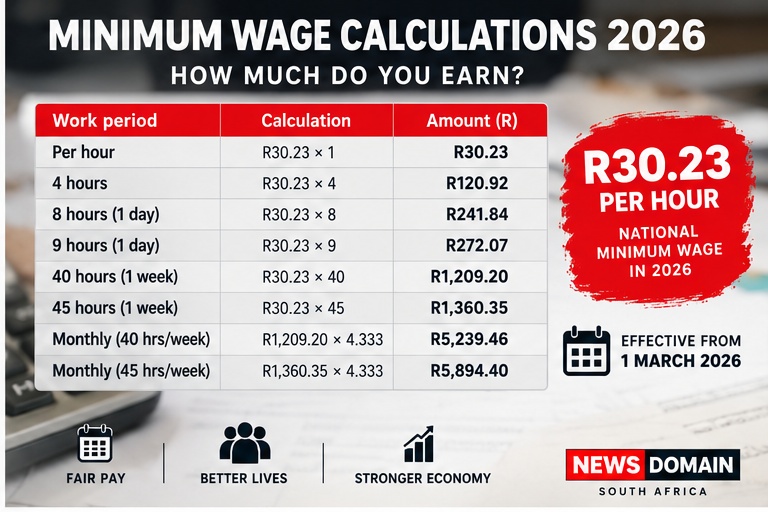
There is no single minimum daily salary that applies regardless of how many hours someone works.
The calculation depends on the employee’s ordinary working hours.
For an employee working 8 ordinary hours:
R30.23 × 8 = R241.84
For an employee working 9 ordinary hours:
R30.23 × 9 = R272.07
These calculations are also provided by the Department of Employment and Labour in its 2026 minimum-wage guidance. (Department of Labour)
Example: 8-hour working day
Suppose Thandi works eight ordinary hours on a particular working day.
Her basic minimum calculation is:
| Calculation | Amount |
|---|---|
| Minimum hourly rate | R30.23 |
| Ordinary hours | 8 |
| Minimum for those hours | R241.84 |
This example concerns ordinary hours only. Other rules may apply to overtime, Sundays, public holidays and other working arrangements.
How much is minimum wage per week in South Africa?
For a 40-hour working week:
R30.23 × 40 = R1,209.20
For a 45-hour working week:
R30.23 × 45 = R1,360.35
Therefore:
| Weekly ordinary hours | Basic calculation |
|---|---|
| 40 hours | R1,209.20 |
| 45 hours | R1,360.35 |
These are gross calculations before considering applicable deductions and other payroll factors.
How much is minimum wage per month in South Africa in 2026?
This is one of the most important points to understand:
South Africa’s National Minimum Wage is an hourly rate, not one universal monthly salary.
A person’s monthly earnings depend on the number of ordinary hours worked.
The Department of Employment and Labour’s official 2026 flyer gives these illustrative monthly calculations:
40 hours per week
R30.23 × 40 hours = R1,209.20 per week
Using the Department’s monthly conversion:
R1,209.20 × 4.333 = approximately R5,239.46 per month
45 hours per week
R30.23 × 45 hours = R1,360.35 per week
Using the same conversion:
R1,360.35 × 4.333 = approximately R5,894.40 per month
These figures should therefore be described as monthly equivalents based on specific working hours, rather than as a single statutory “monthly minimum wage.”
Minimum wage calculator for common working hours
The following examples make the R30.23 hourly rate easier to understand.
| Ordinary hours | Calculation | Amount |
|---|---|---|
| 1 hour | R30.23 × 1 | R30.23 |
| 4 hours | R30.23 × 4 | R120.92 |
| 5 hours | R30.23 × 5 | R151.15 |
| 6 hours | R30.23 × 6 | R181.38 |
| 7 hours | R30.23 × 7 | R211.61 |
| 8 hours | R30.23 × 8 | R241.84 |
| 9 hours | R30.23 × 9 | R272.07 |
| 40 hours | R30.23 × 40 | R1,209.20 |
| 45 hours | R30.23 × 45 | R1,360.35 |
ANALYSIS: These calculations simply multiply the statutory R30.23 hourly minimum by the number of ordinary hours shown. They do not attempt to calculate overtime, deductions, Sunday rates, public-holiday rates or other employment benefits.
Does the R30.23 minimum wage apply to domestic workers?
Yes.
Domestic workers are entitled to the R30.23 per hour National Minimum Wage from 1 March 2026.
The official Government Gazette specifically lists domestic workers at R30.23 per hour. (Department of Labour)
Domestic work can include workers such as:
- Housekeepers
- Cleaners employed in private households
- Garden workers employed by households
- Certain household caregivers
- Other workers falling within the applicable domestic-worker framework
Employers should not assume that employing someone in a private home means normal minimum-wage rules do not apply.
How much should a domestic worker earn per day in 2026?
If a domestic worker performs eight ordinary hours of work:
R30.23 × 8 = R241.84
If nine ordinary hours are worked:
R30.23 × 9 = R272.07
However, employers need to consider more than simply multiplying hours by R30.23.
Working-time rules, leave, UIF obligations and other employment protections can also apply.
The National Minimum Wage establishes the wage floor; it does not replace the rest of South Africa’s employment-law framework.
Does the minimum wage apply to farm workers?
Yes.
Farm workers are also entitled to R30.23 per ordinary hour worked from 1 March 2026.
The Government Gazette explicitly lists both farm workers and domestic workers at the national R30.23 rate. (Department of Labour)
This is useful to clarify because South Africa historically had different wage arrangements for some vulnerable sectors. Workers should use the current rules rather than relying on old wage tables circulating online.
What is the EPWP minimum wage in 2026?
Expanded Public Works Programme workers have a different rate.
The minimum wage for an EPWP worker increased to:
R16.62 per hour
from 1 March 2026.
The previous EPWP rate was R15.16 per hour. (Department of Labour)
This means somebody working under the applicable EPWP dispensation should not automatically use R30.23 when calculating the statutory minimum.
EPWP example
For eight hours at R16.62:
R16.62 × 8 = R132.96
This is a simple illustrative calculation and does not establish what an individual worker’s total pay should be after considering their full employment arrangement.
What about workers on learnerships?
Workers who have entered qualifying learnership agreements contemplated in section 17 of the Skills Development Act are treated differently.
Instead of simply applying the general R30.23 rate, the official determination provides learnership allowances in Schedule 2.
The amount can vary according to the type or level of learnership.
Anyone on a learnership should therefore check the relevant Schedule 2 allowance rather than assuming that either the standard National Minimum Wage or EPWP rate automatically applies. (Department of Labour)
Do tips count as part of the minimum wage?
The Department of Employment and Labour’s 2026 guidance states that its wage calculations exclude additional benefits, allowances and tips. (Department of Labour)
This distinction is particularly important for workers in industries where tips are common.
An employer should not simply look at all money a worker happened to receive and assume that every payment can be treated as part of the statutory hourly minimum.
What if you work less than four hours?
The Department of Employment and Labour states that an employee or worker who works for less than four hours on a day must be paid for four hours of work on that day. (Department of Labour)
At the 2026 National Minimum Wage, four ordinary hours are:
R30.23 × 4 = R120.92
This can be particularly important for workers who are called in for very short shifts.
However, individual circumstances can matter, so workers with a pay dispute should obtain guidance based on their actual employment situation.
Can an employer reduce working hours because minimum wage increased?
Employers should be careful about trying to circumvent minimum-wage obligations by unilaterally changing employment conditions.
The Department has previously emphasised that the National Minimum Wage cannot simply be varied by contract or collective agreement and has warned against employers unilaterally changing hours or other conditions of employment as a way of implementing a minimum-wage adjustment. (Department of Labour)
This does not mean working hours can never legitimately change.
It means the existence of a higher minimum wage should not be treated as permission to ignore other employment-law requirements.
Is minimum wage the same as your take-home salary?
No.
The minimum wage refers to the applicable minimum remuneration for ordinary hours worked.
Your take-home pay is what remains after applicable deductions.
Depending on the employee and circumstances, a payslip can contain deductions or contributions such as UIF.
It is therefore possible for a calculation based on R30.23 multiplied by ordinary hours to differ from the amount that ultimately reaches the employee’s bank account.
Workers should examine the entire payslip rather than only the final amount.
Is R30.23 a maximum wage?
No.
It is a minimum, not a maximum.
An employer and employee can agree to a higher wage.
For example, there is nothing in the National Minimum Wage that says a worker cannot earn:
- R35 per hour
- R40 per hour
- R50 per hour
- R100 per hour
The R30.23 figure establishes the general statutory floor for workers to whom that rate applies.
Can an employer legally pay less than minimum wage?
Employers cannot simply decide that the National Minimum Wage is unaffordable and therefore ignore it.
However, the National Minimum Wage Act provides an official process through which an employer or qualifying employers’ organisation can apply for an exemption.
The Department explains that an approved exemption must specify the period for which it applies, cannot run for longer than one year, and must state the wage the employer is required to pay. (Department of Labour)
Therefore, “my employer says they cannot afford R30.23” is not, by itself, proof that paying below the minimum is lawful.
An actual exemption is a formal matter.
What should you do if you are being paid below minimum wage?
First, calculate your ordinary hourly rate carefully.
For example, if you worked 40 ordinary hours during a week:
40 × R30.23 = R1,209.20
Then compare this with your wage information and payslip.
Do not immediately assume there is a violation simply because your bank deposit looks lower. Check the hours, pay period and deductions shown on your payslip.
If you believe you are being paid below the applicable National Minimum Wage, the Department of Employment and Labour’s 2026 guidance says workers can lodge a complaint at their nearest Department of Employment and Labour office or the Commission for Conciliation, Mediation and Arbitration (CCMA). (Department of Labour)
Department of Employment and Labour
Why did the minimum wage increase in 2026?
The 2026 increase moved the National Minimum Wage from R28.79 to R30.23.
The Department has linked the adjustment to the need to protect low-paid workers while responding to economic pressures, including increases in living costs.
In an August 2026 statement, Employment and Labour Minister Nomakhosazana Meth said the National Minimum Wage remained an important protection in sectors including domestic work, agriculture, hospitality and retail, while noting continued cost-of-living pressure on households. (Department of Labour)
The National Minimum Wage Commission is responsible for reviewing the wage and recommending adjustments. Its statutory functions include assessing the impact of the minimum wage on the economy, collective bargaining and income differentials. (Department of Labour)
Minimum wage 2025 vs 2026
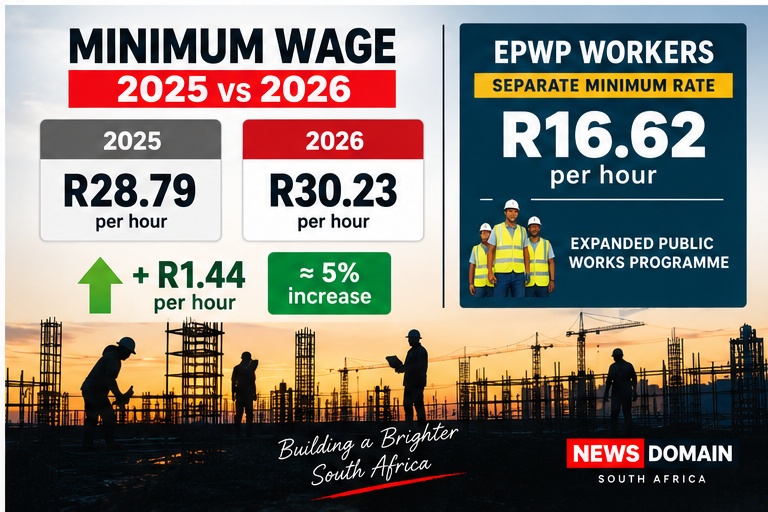
The increase can be seen clearly by comparing the two years:
| Year | National Minimum Wage | Difference |
|---|---|---|
| 2025 | R28.79/hour | — |
| 2026 | R30.23/hour | +R1.44/hour |
For someone working 40 ordinary hours a week, the difference before other factors is:
R1.44 × 40 = R57.60 more per week
For 45 ordinary hours:
R1.44 × 45 = R64.80 more per week
ANALYSIS: These figures illustrate the mathematical difference between the 2025 and 2026 hourly rates. Actual changes in a worker’s earnings can differ because of hours, employment arrangements, deductions and other factors.
Minimum wage does not replace other worker rights
Being paid R30.23 per hour does not mean an employer has automatically complied with every South African employment requirement.
Minimum wage is only one part of the employment framework.
Other rules can deal with matters such as:
- Working hours
- Overtime
- Meal intervals
- Leave
- Sunday work
- Public holidays
- Night work
- Rest periods
- UIF
- Termination of employment
Workers should therefore avoid interpreting “I earn minimum wage” as meaning that R30.23 is the only number or employment condition that matters.
Frequently asked questions
What is the minimum wage in South Africa in 2026?
The National Minimum Wage is R30.23 per ordinary hour worked from 1 March 2026. (Department of Labour)
How much is minimum wage for an 8-hour day?
At R30.23 per hour:
R30.23 × 8 = R241.84
The Department of Employment and Labour uses the same calculation in its official 2026 guidance. (Department of Labour)
How much is minimum wage for a 40-hour week?
A 40-hour week at the statutory hourly minimum equals:
R1,209.20
before considering applicable deductions or additional payments.
How much is minimum wage per month in 2026?
There is no single universal monthly minimum because the National Minimum Wage is hourly.
The Department’s illustrative calculations give approximately R5,239.46 per month for a 40-hour week and R5,894.40 for a 45-hour week, using a 4.333-week monthly conversion. (Department of Labour)
What is the minimum wage for domestic workers in 2026?
Domestic workers are entitled to R30.23 per ordinary hour from 1 March 2026. (Department of Labour)
What is the minimum wage for farm workers in 2026?
Farm workers are also entitled to R30.23 per ordinary hour. (Department of Labour)
What is the EPWP minimum wage for 2026?
Workers employed under the Expanded Public Works Programme have a minimum rate of R16.62 per hour. (Department of Labour)
Are learnerships paid R30.23 per hour?
Not necessarily. Qualifying learnership agreements are covered by the separate allowances contained in Schedule 2 of the 2026 determination. (Department of Labour)
What can I do if my employer pays below minimum wage?
Check your hours and payslip first. If you believe the applicable National Minimum Wage is not being paid, the Department advises workers to lodge a complaint with the Department of Employment and Labour or the CCMA. (Department of Labour)
What South African workers should remember
The most important number is:
R30.23 per ordinary hour.
That is South Africa’s general National Minimum Wage from 1 March 2026, including for domestic and farm workers.
For common working patterns, that works out to R241.84 for eight ordinary hours, R1,209.20 for 40 hours and approximately R5,239.46 per month when using the Department’s 40-hour-week monthly calculation. (Department of Labour)
Workers should remember that the monthly figure is an example rather than a universal statutory monthly salary.
EPWP workers and qualifying learnerships have separate arrangements.
If you believe you are being paid below the applicable minimum, check your payslip and working hours and use official Department of Employment and Labour or CCMA channels for assistance.
INTERNAL LINK OPPORTUNITY:
SASSA Grant Payment Dates 2026/2027: Full Schedule and Grant Amounts
A natural internal-link sentence could be:
For households that also receive social assistance, see News Domain’s guide to the SASSA Grant Payment Dates 2026/2027 and current grant amounts.
Sources & References
The main source for this article is the official 2026 National Minimum Wage determination published by the Department of Employment and Labour in Government Gazette No. 54075. It confirms the R30.23 general rate, R30.23 domestic and farm-worker rates, R16.62 EPWP rate and separate learnership allowances. (Department of Labour)
The Department’s official 2026 National Minimum Wage information flyer provides its daily, weekly and monthly examples and guidance for workers who believe they are underpaid. (Department of Labour)
Official Department of Employment and Labour minimum wage announcement
Fact, analysis and opinion note
FACT: The R30.23 hourly National Minimum Wage, effective date, EPWP rate and worker categories described above are based on official Department of Employment and Labour and Government Gazette information.
ANALYSIS: News Domain’s worked examples explain what the official hourly figures mean at different working hours. They should not be interpreted as individual payroll calculations.
OPINION: No opinion has been used to determine the legal minimum-wage figures in this article.