This is an opinion and analysis piece, presenting the writer’s argument alongside multiple perspectives on a contested policy question. It should be read as analysis, not as a news report of settled fact.
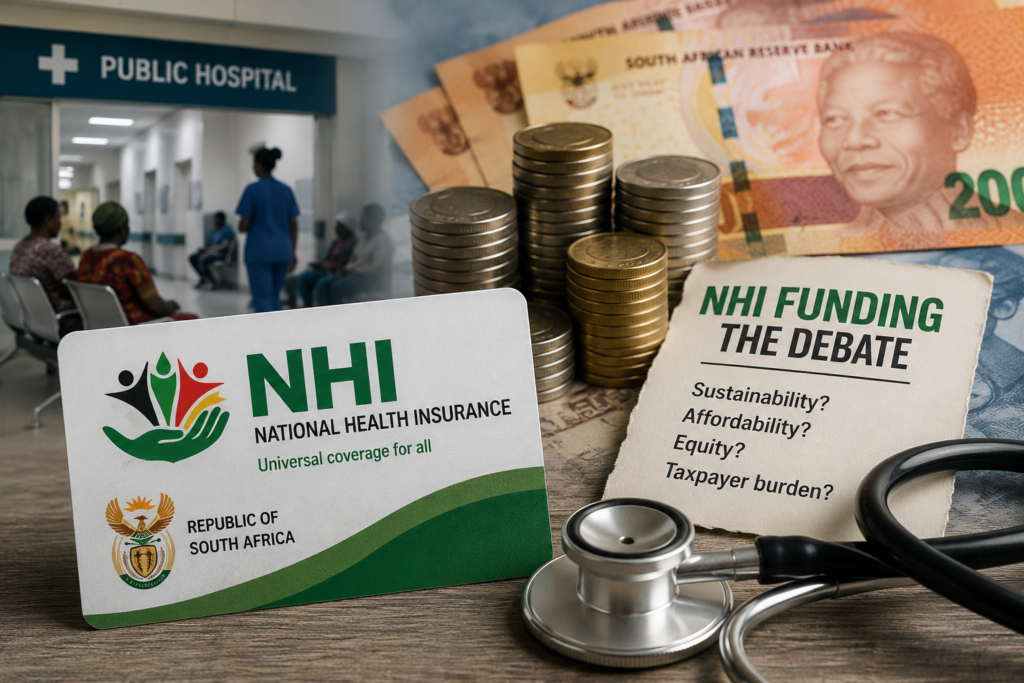
National Health Insurance is meant to guarantee every South African access to quality healthcare regardless of income — an aim almost nobody in the public debate actually disagrees with. The disagreement, when you strip away the noise, is almost entirely about money: whether South Africa can fund a universal healthcare system of this scale without either an unrealistic tax increase or a slow collapse into an underfunded, dysfunctional version of the plan on paper.
The equity case is genuinely strong
South Africa runs two largely separate healthcare systems — a private sector serving a smaller, better-resourced share of the population well, and a public sector serving the majority under significant strain. That divide tracks closely with income and, historically, with race, and it’s a legitimate constitutional and moral problem for a country that guarantees a right of access to healthcare. NHI’s underlying goal — pooling resources so that access to care depends on need rather than the ability to pay a private medical scheme — is not a fringe idea; it’s the model most wealthy democracies with universal healthcare have converged on in some form.
Where the debate actually gets difficult
The Health Department has previously indicated NHI would require in the region of R200 billion a year in additional funding — a figure that implies either a significant tax increase (with a VAT rise from 15% to 21.5% one figure that has circulated in the debate) or major reallocation from other budget priorities. Given that South Africa’s 2026 Budget just withdrew a much smaller proposed VAT increase — see our recap, the 2026 Budget’s decision to hold VAT at 15% — specifically because of the burden it would place on households already under cost-of-living pressure, it’s difficult to see a straightforward political path to a tax increase several times larger in service of NHI.
This is where NHI’s advocates and critics often talk past each other. Advocates are usually arguing about the destination — universal, equitable access to care. Critics are more often arguing about the vehicle — whether this specific funding and governance model can actually get there without breaking something on the way.
The governance question is separate from, and just as important as, the money question
Even a fully funded NHI would depend on administrative and clinical governance capacity that South Africa’s public health system has struggled with for years — procurement failures, staff shortages in some facilities, and uneven quality of care between provinces. Critics, including some healthcare funders and medical associations, have argued that centralising healthcare purchasing through a single NHI Fund concentrates that governance risk rather than distributing it, and that a funding announcement alone doesn’t resolve underlying capacity constraints.
A delay is not automatically bad faith
Government has reportedly agreed to delay proclaiming certain sections of the NHI Act pending a Constitutional Court ruling on flaws in the public participation process that produced the legislation. It would be easy to frame that delay purely as either principled caution or cynical obstruction, depending on which side of the debate one starts from. The more accurate reading is probably more boring: a major, contested piece of legislation facing a legitimate procedural legal challenge is exactly the kind of thing that should be resolved through the courts before full implementation proceeds, regardless of one’s underlying view on the policy’s merits.
What would move this debate forward
The most useful thing government could do for public trust is not a fresh round of framing NHI as an equity imperative — that framing has already been made, repeatedly, and it isn’t in serious dispute. It’s a credible, detailed funding plan that survives scrutiny from independent economists, showing precisely how the R200 billion-plus gap gets closed without either an unsustainable tax burden or a hollowed-out version of the promised benefits. Until that document exists and withstands scrutiny, both sides of the NHI debate are, to some extent, arguing about a plan that hasn’t yet been fully specified.
Where this leaves South Africans
NHI’s goal deserves support. Whether the current version of NHI, as legislated, can actually deliver that goal without a credible funding answer is a separate, unresolved question — and treating skepticism about the funding model as equivalent to opposing universal healthcare itself does a disservice to a debate that deserves more precision than it currently gets from either side.
Sources Used
- National Department of Health — NHI implementation updates
- Spotlight — 'As NHI stalls, the real debate is about trade-offs'
- Wits Vuvuzela — NHI governance debate coverage
What other countries’ universal healthcare transitions suggest
Countries that have successfully transitioned to universal healthcare systems have generally done so over long timeframes — often decades — with funding models phased in gradually and adjusted based on real-world fiscal experience, rather than implemented as a single, fully formed system from day one. This international pattern doesn’t settle South Africa’s specific NHI debate, but it does suggest that a phased, adaptable approach — which NHI’s own multi-phase design at least notionally reflects — is more consistent with how comparable transitions have actually succeeded elsewhere than an all-at-once implementation would be. Whether NHI’s specific phasing and funding design will prove adaptable enough in practice remains to be seen.
Why private medical schemes are watching closely
Medical schemes and their members have a direct stake in how NHI’s relationship with private healthcare is ultimately structured — whether private medical aid continues to exist as a parallel option, becomes a supplementary top-up to NHI coverage, or is phased out over time. Statements suggesting medical schemes are unlikely to be materially affected for ten to fifteen years even after implementation offer some reassurance to current members, but they are also, by their nature, statements about intentions rather than guarantees, given how much can change in policy and funding realities over a decade or more.
A middle path worth taking seriously
Between full NHI implementation as currently designed and abandoning the goal of universal healthcare altogether, there is a middle path some health economists have proposed: a phased, means-adjusted expansion of public healthcare funding and quality, moving toward universal coverage incrementally as fiscal capacity and administrative capability genuinely allow, rather than committing to a single funding model and implementation date years in advance. Whether this represents a pragmatic alternative or simply a slower version of the same destination is itself part of the unresolved debate.
Why this debate will likely outlast any single budget cycle
Given the scale of funding NHI would require, and the multi-year, phased implementation timeline the Health Department has set out, this debate is unlikely to be resolved by any single budget announcement or court ruling. It will more likely continue playing out incrementally, through successive funding decisions, legal challenges, and phased implementation milestones over several years — meaning the underlying tension between NHI’s equity goals and its funding feasibility deserves sustained public attention rather than a one-off news cycle’s worth of scrutiny.
What a credible funding plan would need to show
At minimum, a credible NHI funding plan would need to specify the funding mechanism in detail, model its effect on households across different income levels, and set out contingency plans if revenue collection falls short of projections — the kind of detailed fiscal modelling South Africans have seen for other major budget decisions, but which has not yet been presented publicly for NHI at a comparable level of detail.